The Old Navy

The Old Navy

Daniel P. Mannix

Daniel P. Mannix

Daniel Pratt Mannix 3rd was the quintessential man of his time and the manner in which he lived his life mirrored the strengths and weaknesses of his age. At four, he spoke Mandarin Chinese better than he did English. When he went out to play he wore a false pigtail pinned to the back of his cap. It was a practical necessity for a little American boy in the China of 1882 who wanted to be accepted by his Chinese playmates; it was also the beginning of a lifetime education in the ways of the world. His country was embarking on a similar education. Pratt's father was a Marine officer who had been "lent" to Empress Dowager Tzu Hsi's government for the purpose of opening a torpedo school to train Chinese technicians. The mission of the ship on which he served was to "open Korea" — then a vassal state of China's — as Commodore Perry had recently opened Japan. The United States was taking its first steps away from a hundred self-sufficient years of "splendid isolation". In 1885, when the Mannix family left China, the U.S. Army was smaller than Switzerland's, and the Navy could not boast even one battleship. By 1898, when Pratt was a second classman at Annapolis, the Navy had grown. In fact, one of its several battleships, the Maine, mysteriously blew up in Havana harbor. Pratt kept a diary of his service on the U.S.S. Indiana during the war with Spain that followed that incident, unwittingly chronicling the fading era of wooden ships and iron men. It was a short war and when it was over the spoils of victory brought the United States a new international respect. "In a few short months," President McKinley said, "we have become a world power." For the quarter century following his graduation, in June 1900, Pratt Mannix followed the sea — with fierce devotion to his country, with endless enthusiasm for discovering the distant and unfamiliar. He was not disappointed. There was beauty — the breathtaking first view of the towers of Constantinople at sunrise; satisfaction — having a new oil-burning destroyer as his first command, and quelling a riot without a single shot fired. There were unique challenges — in the Philippines, dodging the equally murderous charge of water buffalo as well as the surgically precise aim of a barong by a Moro guerrilla, or, in Germany, avoiding a Prussian duel by serving a brandy smash punch beforehand. But the most perilous challenge of all was participating in the highly secret mine barrage in the last months of World War I. A total of 70,113 steel globes packed with TNT were planted in 230 miles of the North Sea between Norway and Scotland as a final deterrent to the German U-boat "stilettos". The breadth and pace of this fascinating memoir are as much a reflection of the man who lived it as they are of the dramatic era it records. Fighter, peacekeeper; pragmatist, romantic; humorist, philosopher; lover, husband, father — he was each of these. Of necessity, and later by preference, Pratt spent little time in his homeland. There are some men who truly are, like Pratt perhaps, Whitman's voyager on "trackless seas, fearless for unknown shores".
Read online
  • 605
The Hellfire Club

The Hellfire Club

Daniel P. Mannix

Daniel P. Mannix

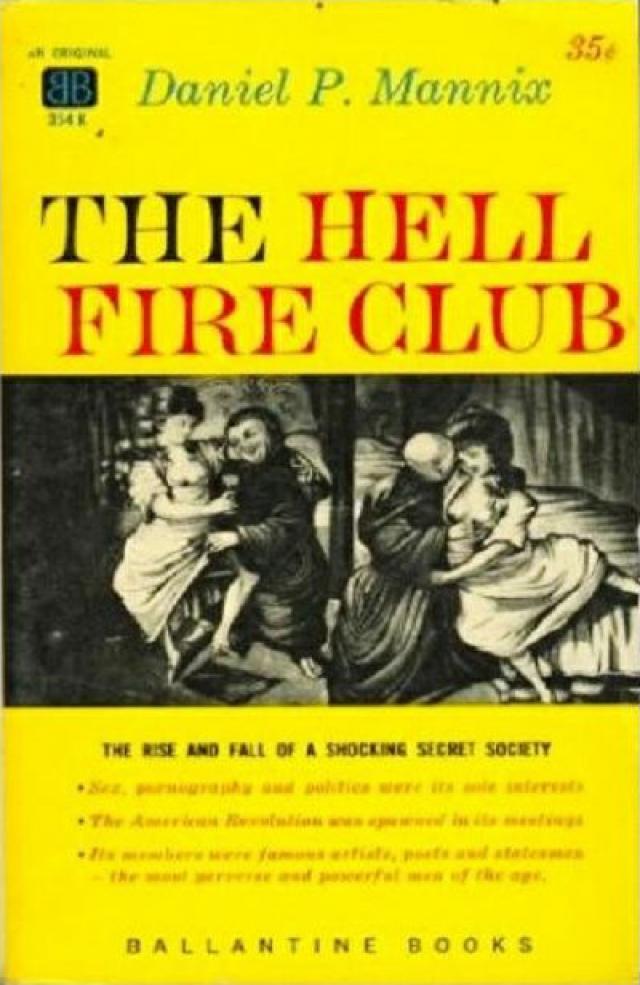
Epub v4 (mine)Brilliant, amusing, and utterly immoral, young noblemen, politicians, artists and other eminent men of eighteenth century England thronged to the abbey of Medmenham and the elaborately decorated caves and gardens of West Wycombe Park to attend meetings of a club that outraged and threatened the security of an entire country – the notorious Hellfire Club. Dedicated to black magic, sexual orgies, and political conspiracies, the records of their elaborately obscene rituals, jests, and parties have both fascinated and appalled the world for over three centuries.The Hellfire Club became popular during an age of scandal. Standards of respectability had become middle class – a middle class who knew nothing of art and literature and whose outlook was bound by a set of stereotyped conventions. Respect for the monarchy, religion, or the ideals of decency and morality? Bah humbug. The club's members – “mad geniuses who. . . could do anything from writing double entendre verses in Greek to ruining an opposing statesman by a clever satirical sketch” – set out to ridicule and destroy these conventions and at times they almost succeeded.The originator and guiding presence of the Hellfire Club was Sir Francis Dashwood – son of a grim and fiercely ruthless baronet, heir to one of the great fortunes of the time, and George III's intimate friend. Possessing a flair for politics and a proclivity for the profane, it is largely because of his influence that the Hellfire Club was to eventually count among its members the Prime Minister of England, the Chancellor of the Exchequer, the Lord Mayor of London, the First Lord of the Admiralty, the son of the Archbishop of Canterbury, several of England's greatest artists and poets, the Prince of Wales, and Benjamin Franklin.Red robes, screaming girls, unscrupulous madams, firelight on the walls of a cave, and unspeakable acts for the sake of amusement. Daniel P Mannix addresses the reasons for the rise of the Hellfire Club, its singular influence on the course of history, and its inevitable destruction.
Read online
  • 538
The Healer

The Healer

Daniel P. Mannix

Daniel P. Mannix

In a novel that memorably evokes a rural American countryside and its wildlife, Daniel P. Mannix leads us into the magical existence of a boy groping toward maturity in a primitive but exciting environment. The story unfolds among the woods and farms of the Pennsylvania Dutch country, where the boy Billy comes from an unhappy city home to live with his great-uncle, Abe Zook, a "braucher" or hex doctor skilled in herbal healing and widely feared as a powwow man and master of magic.Under the tutelage of old Abe, Billy begins to learn the secrets of collecting herbs, running a farm and otherwise making a living from nature. His companions are the farm dog Wasser, the tame raven Grip, the trained owl Dracula. Important in his new life are two outcast animals, the bitch Blackie and the coyote Wolf, abandoned pets now gone to the wild and so elusive and savage that they are feared throughout the countryside and hunted by the superstitious farmers as werewolves. When the farmers start losing sheep and chickens, Billy joins them and their hounds in trying to run down the coyote and its mate.As season follows season the "werewolves" come to play a steadily more important role in the boy's emotional world. Billy's life is in grave danger when he meets the "werewolves" in the winter woods, and later their marauding coydog offspring. Yet his instinctive sympathy for rejected creatures makes him the ally and defender of Wolf and Blackie. At the same time, he and his great-uncle are forced to defend their own right to wrest a living from nature against the restrictions of civilization as typified by government regulations and game wardens. Gradually, surviving conflict and near-disaster, the boy develops a new maturity and purpose.This sensitive and poetic novel is distinguished by Daniel P. Mannix's talent for recreating the lives of animals and of people who live in close contact with the outdoors. Seldom does a novel so naturally combine powerful suspense, subtle humor, little-known nature lore, and a preception that reaches deep into the ways of men, boys, and animals.
Read online
  • 37
155