The guyana quartet, p.1
The Guyana Quartet, page 1
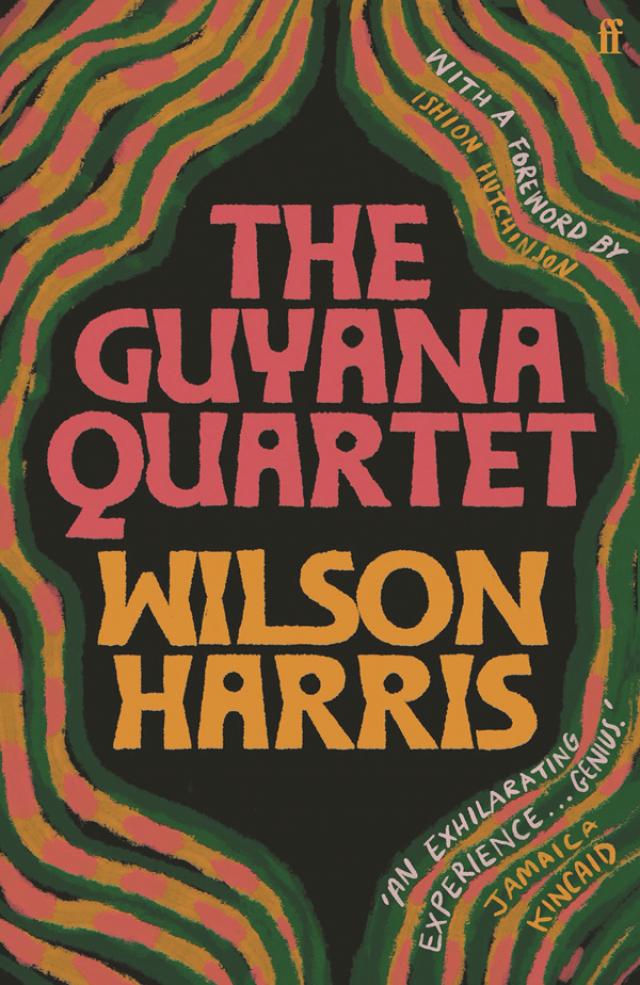


THE GUYANA QUARTET
WILSON HARRIS
The Guyana Quartet
with a foreword by
Ishion Hutchinson
Contents
Cover
Title Page
Contents
Foreword by Ishion Hutchinson
A Note on the Genesis of The Guyana Quartet
Palace of the Peacock
Dedication
Epigraphs
Book One: Horseman
I
II
III
Book Two: The Mission of Mariella
IV
V
VI
Book Three: The Second Death
VII
VIII
IX
Book Four: Paling of Ancestors
X
XI
XII
The Far Journey of Oudin
Dedication
Epigraph
Book One: The Covenant
I
II
III
IV
V
Book Two: The Husbandmen
VI
VII
VIII
IX
Book Three: Second Birth
X
XI
XII
The Whole Armour
Dedication
Epigraphs
Book One: Jigsaw Bay
I
II
III
IV
Book Two: The Eagles
V
VI
VII
VIII
Book Three: Time of the Tiger
IX
X
Book Four: All the Aeons
XI
XII
The Secret Ladder
Dedication
Epigraphs
Book One: The Day Readers
I
II
III
IV
Book Two: The Night Readers
V
VI
Book Three: The Reading
VII
Pursuing the Palace of the Peacock by Kenneth Ramchand
About the Author
By the Same Author
Copyright page
Foreword
by Ishion Hutchinson
The four years in which the novels of The Guyana Quartet were published, from 1960 to 1963, remain the anni mirabiles of fiction from the English-speaking Caribbean. The title unites their geographic setting, Guyana, a country on the north Atlantic coast of South America, and their prose style, the music of a fantastical baroque language. They are works of compressed turbulence and beauty, each just over a hundred pages. World-wondering as their individual titles – The Palace of the Peacock, The Far Journey of Oudin, The Whole Armour and The Secret Ladder – the omnibus Quartet, issued in 1985, comes to just under five hundred pages.
The length is important for a work usually given the distinction of ‘epic’; it alerts us to Wilson Harris’s gift of crystallisation. His fiction is close to Greek tragedy, and as a superb tragedian novelist, Harris’s central theme is evil, specifically the evil of conquest. This evil resides in the fallen Eden of Guyana, a lost paradise in the Quartet that its various transplanted inhabitants are trying, and failing, to regain. They cannot regain this lost paradise precisely because they are transplanted and they have no claim, in the biblical sense, of first estate.
Written with the human terror of a Euripides, the novels are cinched by a lyrical apocalypticism. Tormented, characters enter into different kinds of expiation. They end up lost on the river or in the rainforest. Most die, and then die again. Their second death brings them into, to use Harris’s wonderful phrase, ‘the inimitable trauma of joy’. The trauma of joy is a mania verging on divine madness. In different registers across the Quartet, this trauma is the final release its characters experience. But often there is just trauma without joy, and the novels cleave to the most undivine madness of all: the brutal post-Edenic struggle for survival.
Expulsion takes the form of expeditions in the novels. Palace is the expedition upriver, led by the monomaniacal Donne in pursuit of the Amerindian ‘folk’ he wishes to re-enslave; one strand of expedition in Oudin is the labourer Oudin’s and Beti’s flight into the rainforest, pursued by Beti’s drunken cousin, Mohammed; Cristo, of Armour, is likewise on the run from the law in the rainforest where, at some point during his forty days and forty nights run, he is joined by his lover Sharon; and in Ladder ‘the foolish lovers’ Bryant and Catalena also escape into the rainforest after an accidental killing, fleeing from vigilante violence of attempted rape and murder.
These expulsion-as-expeditions underscore the fugitive nature of the books. The landscape itself is fugitive. The rainforest, the sea, the river are frontiers on the move from the old, undiminished El Dorado looming into modern Guyana. As these expeditions inevitably end in failure, horror and sadness, just like the quest for El Dorado in the sixteenth and seventeenth centuries where the Quartet opens, a new inner adventure of homecoming breaks forth, traumatic, promising and joyful.
Palace of the Peacock is set in the European conquistadorial period of Guyana’s history. The exact time, like its title, remains vague. Upon until the very end, it is a novel cast in extreme chiaroscuro. It operates as a dream in which images rise and fall with their own logics of assurance. One could call it poetic logic. And so it begins, unfolding with such assurance:
A horseman appeared on the road coming at breakneck stride. A shot rang out suddenly, near and yet far as if the wind had been stretched and torn and had started coiling and running in an instant. The horseman stiffened with a devil’s smile, and the horse reared, grinning fiendishly and snapping at the reins. The horseman gave a bow to heaven like a hanging man to his executioner, and rolled from his saddle on to the ground.
The action is montage at breakneck speed. The anonymity of the horseman, and no less the anonymity of the violence in his wake, has overtones of various heroic and antiheroic conventions: the loner hero of the Wild West frontier or Death of Revelation 6:8, seated on his pale horse. ‘Hell followed with him,’ the biblical verse says, and indeed hell follows this horse rider, Donne, shot dead (but not dead) by Mariella, an Amerindian woman he has abused.
When Donne’s name first appears, he is said to have ‘always possessed a cruel glory’. His unspoken motto is ‘Gold, God, and Glory’, the same as his Spanish antecedents, the first Europeans in the Americas to pursue the Amerindian legend of El Dorado and make it into a blood-drenched myth. But the name, in origin, is Anglo-Saxon. Donne is then a composite of the sixteenth- and seventeenth-century European conquistadors’ daemonic quest to rule the New World. Europe, the Old World, however, does not figure in Donne’s quest for glory: he is the new New World, a conquistador-settler, frontier man with a plantation, the crop of which is unknown. The unknown is a seal of his cruelty.
Donne’s cruelty is serious and absurd. His desire and pursuit of Mariella and her people is a perversion of the knights in medieval romance. But his brand of absurdity is not tokenised into a chainmail-and-steel-visor conquistador. In fact, Donne is never described, turning his invisibility into his invincibility. The chivalric crusading permits him a sincerity that is neither romantic nor sentimental.
Early in the novel he says to the I-narrator, the ghostly twin he calls Dreamer:
‘I’m the last landlord. I tell you I fight everything in nature, flood, drought, chicken hawk, rat, beast, and woman. I’m everything. Midwife, yes, doctor, yes, gaoler, judge, hangman, every blasted thing to the labouring people. Look man, look outside again. Primitive. Every boundary line is a myth. No-man’s land, understand?’
It is the melodrama of the plantocracy full of such maniacal flourishes: ‘Rule the land,’ he said, ‘while you still have a ghost of a chance. And you rule the world.’ With this terrible voice, Donne cries out in the rainforest for his spectral boat-crew, and they arrive to fulfil his daemonic quest to rule the land.
Donne’s men are like the ‘momentous men’ on Ahab’s Pequod, adventure-seeking, ineffectual mercenaries. As Donne is the similitude, a simulacrum, of sixteenth- and seventeenth-century conquistadors, the men too have their basis in history. But that history is personal, Harris’s own. Mixed race and geographically diverse, they are men Harris knew when he led surveying expeditions into the rainforests of Guyana in the 1940s and 1950s, all except the old man, Schomburg, who is based on Robert Hermann Schomburgk, the nineteenth-century German-born explorer of British Guiana. The men arrive to Donne like ‘upright spiders’, the very image of human frailty the novels will repeat. The men, living harrowing lives on the coast of Guyana, are shipwrecked even before leaving land.
They suffer more on the river, sprawled in an undifferentiated mass of the living and the dead. Indeed, the crew is dead. But the men return in a continuous cycle of death and resurrection in the name of the evil of conquest. Once again they arrive in the Amerindian village of Mariella which the old crew, with Donne, had nearly wiped out. On sighting Donne and his resurrected crew, the surviving Amerindians flee into the rainforest.
In a frozen stasis over the next three days, the crew relive, in night and day terrors, the trauma of their earlier exploits. Quickly but in slow, shadowy tableaux, they devolve into madness. The I-narrator’s haunting hallucination is a vivid moment of metamorphic mastery:
A dog rose and stood over me. A horse it was in the uncertain grey light, half-wol f, half-donkey, monstrous, disconsolate; neighing and barking in one breath, its terrible half-hooves raised over me to trample its premature rider. I grew conscious of its closeness as a shadow and as death. I made a frightful gesture to mount, and it shrank a little into half-woman, half-log greying into the dawn. Its teeth shone like a misty rag, and I raised my hand to cajole and stroke its ageing, soulful face.
The same psychic dissolution touches the landscape of Mariella. Though there is an unbroken drought, the leaves dripped like tears: drought, nature’s cosmic sadness, will play out in all the Quartet novels. And in all the novels, torrential rain brings brief reprieve, flashing back the Edenic beauty of the landscape.
At some point Donne captures (or recaptures) an old Amerindian woman. He forces her to lead the crew upriver in their purgatorial journey – their second deaths – in the final search for her elusive people, the ‘folk’. Her presence causes new disturbances and awakenings in the crew. She stirs in Donne the tiniest inkling of conquistadorial regret. He says to Dreamer: ‘Your faith and intuition may be better than mine. I am beginning to lose all my imagination save that sometimes I feel I’m involved in the most frightful material slavery. I hate myself sometimes, hate myself for being the most violent taskmaster – I drive myself with no hope of redemption whatsoever and I lash the folk.’ He is only continuing his earlier monomaniacal sermon to Dreamer. Still, the pity-seeking tone displays something beyond Donne’s ‘exasperated vanity of ignorance’, to use Joseph Conrad’s phrase. Notice his innocuous and nefarious terms, ‘faith and intuition’, two watchwords that the rest of the novel, and the Quartet as a whole, will break and renew.
Out of the mixed-race crew, the black member Carroll is the first to die. His Orphic whistle will resurrect Donne’s men at the end of the novel. They arrive at a waterfall, its motionless water like a spectacular bridal train. Virginal and paradisiacal, its stone escarpment appears untarnished; yet it is not. Rough ladder steps have been cut into it.
Donne begins to ascend this ladder, but it is an abysmal descent into himself. Physically, mentally and spiritually exhausted he presses his head to the escarpment. Inside the waterfall he sees a room, simple, yet magnificent, and in it, he sees a young carpenter. The carpenter has a rectangular face ‘cut from the cedar of Lebanon’. It is the face of Christ, or so we are to imagine. Donne beholds it and beholds his end.
But Donne’s end, when he falls, is in fact the penultimate catharsis of the Palace. The final exodus comes later in the form of the walking tree transformed into the Palace of the Peacock. In its many-windowed edifice, finally free of the accursed blood myth of El Dorado, Donne and his crew are reborn.
We are to hold this massive palace in our minds as a palatial building that in the classical or ancient sense can represent government. Carroll’s whistle, like Orpheus’s lyre, fills the corridors with golden light. We have sailed into an artifice of eternity. No wonder Harris calls the final few pages of this miracle work ‘the Paradiso phase of the novel’. And in miniature, it is not far off from Dante’s timeless, blessed healing light.
In The Far Journey of Oudin, Harris departs the Guyana of the conquistadors. The rest of the Quartet is set in the 1950s, the decade before Guyana gained its independence from Britain, in 1966. The departure is psychic before it is historical. As in Palace, the same intensity of imperial horror prevails. But with the greater specificity of a contemporary moment, greater specificity of Guyana’s new sociopolitical realities rises to the surface. The novel broods on post-World War II disaffections directly impacting a poor East Indian village on the Demerara-Mahaica frontier of Guyana’s east coast.
At a meeting in a rum-shop between the soon-to-bebankrupt estate owner Mohammed, grieving the death of his brothers, and the old Faustian moneylender Ram, Mohammed, himself Faustian, notices ‘people are saying the atom bomb trials had affected and altered the climate and weather in every continent, reducing a large psychic pool and crowd into a crumbling reflective stream’. Their exchange, which comes near the end of the novel, brilliantly compresses the tinderbox politics of Guyana, set to explode in the coming decades and turning Guyana, a nation of just over 300,000 prior to independence, into a major flashpoint of twentieth-century geopolitical rumblings.
‘The world is a powder keg, man. Why the newspapers say communists penetrating this country from Russia and everybody is to be called “comrade”.’ His eyes glinted with satisfaction when he saw Mohammed had begun to show interest and to warm up.
‘What you mean.’
‘I mean you family is not the only one dying out, Mohammed. You is not the only man frighten of being lonely and disinherit in the future. The other day,’ Ram continued, ‘look what happen. We talking international story of “comrades” so let we talk.’ He saw Mohammed was leaning towards him. ‘Korea – a country just like this I would say’ – he waved his hand generously – ‘split in half, man. What a mix-up family story. God know who is killing who. You is not the only one in this new family trouble. And what happening to you is private, plain AND ordinary compared to that.’
Ram’s speech, as monomaniacal as Donne’s, captures the double conflict of Far: inheritance and intimate caste war.
Despite the insistent realism of the passage above, the plot of the novel is an evanescent blur. The novel’s Tolkienesque title helps: it states a quest adventure and names its peripatetic hero, Oudin. In a society made depraved by the narrow conspiracies and superstitions of village life, Oudin lives in a middle earth of his own brokenness. He is a total isolate, the story’s one absolute loner. The abject loneliness is enclosed in his name: closer to Norse myth, another Tolkienesque aspect, it doesn’t appear to have a connection to an East Indian (whether Hindu or Muslim) identity. The makeshift caste system imported from India absorbs him into the category of the subhuman as it does other characters, primarily women. Oudin eventually becomes enslaved to the Brahmin-like Ram, though Ram’s ancestors are likely Kurmi, a low cultivator caste from the Gangetic plain of India. Ram, then in a grotesque rehearsal of the British nineteenth-century system of indenturing East Indians to the colonies, indentures Oudin to Mohammed.
The narrative at various points wishes to make Oudin something other than a double slave: an earth deity. The most startling instance of this is when Beti, the illiterate teenager recently orphaned to Mohammed’s household, sees Oudin in the mud amid a cluster of ‘courida’, the swamp trees of Guyana.
Staring at the apparition of Oudin that seemed to accompany her all the way, like the sun dark on her shoulder, in the hallucinated trees. Oudin’s extremities – hands and feet – had turned to mud. He had crawled and crept far. He had risen to his feet to follow her, but he carried with him rings around his ankles, and islands off the foreshore, and it was with difficulty he still uprooted and extricated himself.
This is her second sighting of Oudin who has arrived at Mohammed’s estate to herd Mohammed’s stray cattle. But Oudin has two ulterior purposes: to put his master’s brand on Mohammed’s cattle and, more far reaching, to abduct Beti for Ram. The abduction is Ram’s last desperate move to marry and not become, in his rum-shop words to Mohammed, ‘disinherit in the future’.
Oudin abducts Beti for himself, thus ‘horning’ Ram’s future. The abduction puts Oudin’s true far journey into motion, his thirteen years of freedom with Beti, beginning through the rainforest, and eventually settling in their hut on the bank of a river, with Ram next door, demoted from his master to his landlord. For Oudin to secure those thirteen years of freedom with Beti, the universally unlucky number is charged, Oudin strikes a bargain with Ram, the Faustian devil.
The bargain, by a signed contract, is that in the event of Oudin’s death, all his children by Beti belong to Ram. Oudin dies, and his death, which opens the novel, reinstates Ram’s future. It is a death that is both a self-betrayal and betrayal, because it leaves Beti worse dispossessed once the contract gets into Ram’s hand. Knowing this intuitively (she is unable to read and Oudin signs the contract in secret), Beti does the most ordinary and radical thing in the novel, she pries the contract from the fingers of her dead husband and eats it.
The rest of Far deals with the drama of Mohammed and his two full blood-brothers, Kaiser and Hassan, and his cousin Rajah (Beti’s father), bonded together in a ‘brotherhood of conspiracy’. Their greed is boundless. It leads them to murder their unnamed half-brother who has an unspecified disability and who is set to inherit their father’s estate. Their greed is hereditary in part; their father, a second-generation indentured estate owner, acquired his land through hard work and saving but also ‘robbed and killed in the process’, according to Rajah who vehemently hates his uncle. Wife-beaters, contentious and shallow, the conspiratorial brothers all die gruesome deaths in a pattern mirroring that of Donne’s men in Palace.