The best of john jakes, p.1
The Best of John Jakes, page 1


Where no men have gone before,
Venture boldly now.
To the blazing sea of stars,
Point the shining prow.
Range the never-ending dark,
Seeking life’s undying spark.
On beyond all matter’s end,
Bear the race that comes as friend.
Light-years past the last red sun,
Leave the mark of men.
Then turn homeward, toward the day
You go forth again.
—John Jakes
John Jakes
was born in 1932 and raised in Chicago, graduating from De Pauw University with an A.B. degree. He also holds an M.A. from Ohio State University. He began to write while still in college and unlike many writers, he had relatively little difficulty in selling his early efforts. Among the editors who aided and encouraged Jakes were Howard Browne, Damon Knight, and Donald A. Wollheim, who was the first to start him writing historical novels (published under the pen-name of “Jay Scotland”). These books were to prove crucial in providing the experience and recognition for Jakes to undertake the bestselling Bicentennial series. His books have appeared in translation all over the world. John Jakes is named, the father of four children, and lists among his organizations the Authors Guild, the Dramatists Guild and the Science Fiction Writenrs of America.
John Jakes
THE BEST OF
JOHN JAKES
Edited and with an introduction by
Martin Harry Greenberg and Joseph D. Olander
DAW BOOKS, INC.
donald a. wollhiem, publisher
1301 Avenue of the Americas
New York, N. Y. 10019
Published by
THE NEW AMERICAN LIBRARY
OF CANADA LIMITED
Contents :-
Introduction
Machine
from On Wheels
Political Machine
The Sellers of the Dream
The Highest Form of Life
One Race Show
Love Is A Punch in the Nose
There’s No Vinism Like Chauvinism
Recidivism Preferred
Here is Thy Sting
Copyright©, 1977, by John Jakes.
All Rights Reserved.
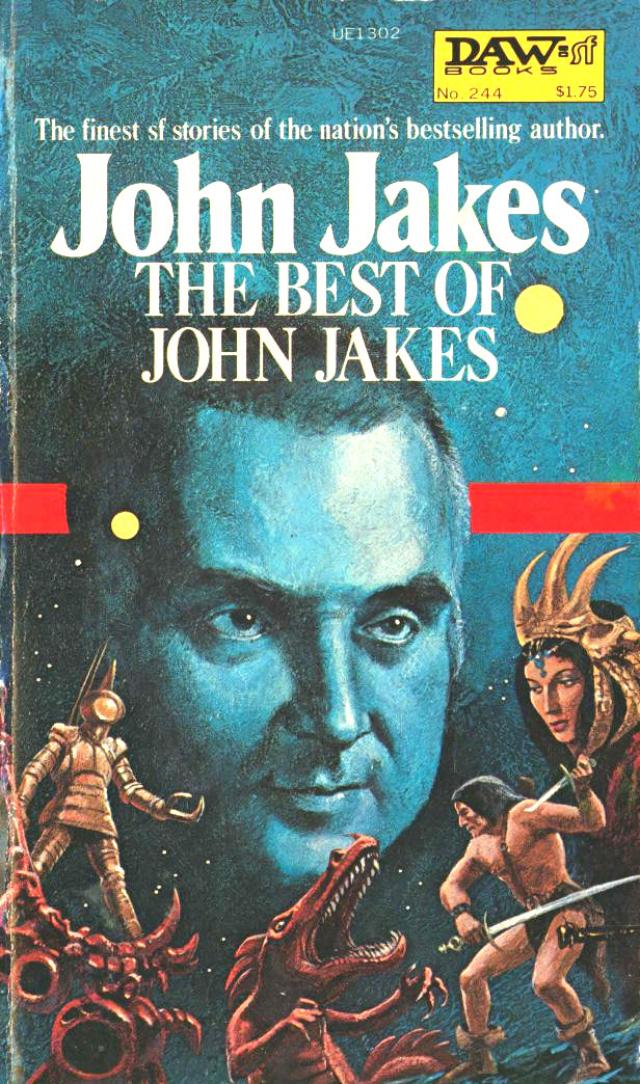
Cover art by Jack Gaughan.
First printing, June, 1977
1 2 3 4 5 6 7 8 9
PRINTED IN CANADA
COVER PRINTED IN U.S.A.
ACKNOWLEDGMENTS
POLITICAL MACHINE, from Amazing Stories, © 1961 by Ziff-Davis Publishing Co. THE HIGHEST FORM OF LIFE, from Amazing Stories, © 1961 by Ziff-Davis Publishing Co. ONE RACE SHOW, from Galaxy, © 1962 by Galaxy Publishing Corp. LOVE IS A PUNCH IN THE NOSE, from Bizarre Mystery Magazine, © 1966 by Pamar Enterprises, Inc. THERE’S NO VINISM LIKE CHAUVINISM, from Amazing Stories, © 1965 by Ziff-Davis Publishing Co. RECIDIVISM PREFERRED, from Amazing Stories, © 1962 by Ziff-Davis Publishing Co. ON WHEELS, © 1973 by Warner Paperback Library. MACHINE, from Fantasy & Science Fiction, © 1952 by Mercury Press, Inc. THE SELLERS OF THE DREAM, from Galaxy, © 1963 by Galaxy Publishing Corp. HERE IS THY STING, from Orbit 3, © 1968 by Damon Knight.
Contents
DEDICATION
For Donald A. Wollheim
Introduction
Science fiction is an attractive genre for many writers, although relatively few can master its form and themes. It is also something of a closed system, with a relatively small group of men and women controlling the sf marketplace and the apparatus by which young writers can achieve sales and recognition. Indeed, in a number of cases, the same individuals perform both the buying and evaluation functions.
Many writers have failed to achieve recognition in science fiction (as they have in all forms of literature) who deserved it. This absence of appreciation derives from a number of sources. For example, young writers often produce uneven work; if their early novels are not well received, their later, better work may not receive the notice due it—reputations are built early in American culture, and it is difficult (but not impossible) to recover from negative reactions at the beginning of a career. It is also possible that a fine professional writer can be simply overlooked among the hundreds of sf books published each year.
Recently, a number of outstanding sf writers of the Fifties and early Sixties have been “rediscovered” or otherwise rehabilitated. Talented craftsmen like T. L. Sherred, Charles Harness, Margaret St. Clair, Wyman Guin, Daniel F. Galouye, and the late Fredric Brown and Mark Clifton were underevaluated and underappreciated during their most productive years. However, in the last few years, writer/editors like Barry Malzberg and Harlan Ellison have contributed to the reputational resurrection of some of these individuals.
Unfortunately, for science fiction most of these writers are no longer active, either because of death, illness, or disillusionment. A few solid writers of the Fifties and Sixties moved on to more lucrative areas of literature —three of the most prominent being John D. MacDonald, Michael Shaara, and John Jakes.
John Jakes has been a phenomenally prolific writer in a business characterized by prolificity. At the age of 44 he is the author of over 200 short stories and SO novels in a variety of fields, not to mention 10 plays and musicals. He has worked in both fiction and non-fiction, concentrating most recently on the historical novel. He is best (at last) known as the author of The American Bicentennial Series; a group of eight novels tracing the evolution of one American family from before the American Revolution to the present day. One hopes that he would consider doing a ninth novel, projecting the Kent family into the future. The first five volumes have enjoyed tremendous success, with total sales of more than 11,000,000 by mid-1976. He is the first writer in history to have four novels (THE FURIES, THE REBELS, THE SEEKERS, and THE TITANS) on the New York Times Book Review best-seller list in a single year. Not bad for a man who started out to be an actor.
John Jakes was born in 1932 and raised in Chicago, graduating from DePauw University in Creencastle, Indiana with an A.B. degree. He also holds an M.A. from Ohio State University. He began to write while still in college and unlike many writers, he had relatively little difficulty in selling his early efforts. In fact, Howard Browne, who bought some of his early stories for Amazing once remarked that Jakes broke into professional writing more easily than anyone he had ever known. Browne was among the first of a number of editors who aided and encouraged Jakes, including Damon Knight, whose words “Try us again” on a rejection slip renewed his confidence, and Donald Wollheim, then of Ace Books, who bought four historical novels from him. Along with the sale of two historicals to Avon (published under the “Jay Scotland” name) these books were to prove crucial to Jakes’ career, since they provided sufficient experience and recognition for him to be invited to write the Bicentennial series for Pyramid.
Jakes sold his first story “Machine” (included in this volume) to the late Anthony Boucher for The Magazine of Fantasy and Science Fiction in 1952 while still a student in college. Between 1952 and 1974 he published a total of 75 science fiction and fantasy stories, as well as 20 novels. During examination week of his senior year~at DePauw he completed his first book, THE TEXANS RIDE NORTH, a fictionalized account of the post-Civil War cattle drives written for young people. He later wrote a number of young adult books, including the non-fiction FAMOUS FIRSTS IN SPORTS; TIROS: WEATHER EYE IN SPACE; MOHAWK: THE LIFE OF JOSEPH BRANT; and a science fiction novel, TIME GATE, which was a selection of the Junior Literary Guild.
For seventeen years following graduation from college he worked at a variety of occupations, principly in the advertising field. When he became a full-time writer in 1971 he left his job as Creative Director of the Dayton office of Dancer Fitzgerald Sample, one of the largest advertising agencies in the United States. Like Frederik Pohl, his experience in advertising found expression in his science fiction, most notably in the novelettes “The Sellers of the Dream” and “There’s No Vinism Like Chauvinism.”
Jakes’ original ambition to become an actor was not completely frustrated since he continues to act in community theater when time permits, most recently in TOBACCO ROAD. His musical talents have resulted in a number of original works including PARDON ME, IS THIS PLANET TAKEN, one of the very few science fiction musicals ever attempted; DOCTOR, DOCTOR!, a musical comedy adaptation of the Moliere farce; SHEPHERD SONG, a musicalization of the SECOND SHEPHERDS’ play; and WIND IN THE WILLOWS, based on the Kenneth Grahame classic.
In science fiction and fantasy, he is perhaps best known as the author of the BRAK THE BARBARIAN books, and while these are solid entertainment they have obscured his more important and serious efforts, for Jakes is a skilled exponent of social commentary and social satire. This is apparent in most of the stories in this book, as well as in a number of his novels, especially BLACK IN TIME (Paperback Library, 1970); SIX-GUN PLANET (Paperback Library, 1970); and ON WHEELS (Warner Paperback Library, 1973).
BLACK IN TIME is one of the few science fiction novels with a Black protagonist and the only one based on the theme of Black history. It is the story of the struggle between Whisk, a white rabble-rouser who uses religion in his battle against the claims and demands of Blacks, and Harold Quigley, a young Black professor who travels back in time studying the history of his people. In brief, the novel revolves around Quigley’s efforts to stop Billy Roy Whisk, who wants to change history in order to perpetuate slavery, and Black militant Jomo, head of Brothers United for Revolution Now (BURN) who wants,
In SEX-GUN PLANET Jakes develops a society patterned on that of the old American West, complete with gunfighters, pinto ponies and wild Indians. But the planet Missouri has a number of interesting features, not the least of which is the fact that some of the gunfighters, ponies, and Indians are robots. If this all sounds somewhat familiar to you, you are right—the idea was very successfully done in film form by Michael Crichton and called WESTWORLD. Missouri is a planet that made a conscious decision to throw out modern technology and a high standard of living in exchange for an ideal, an attempt to rebuild the present with what the inhabitants believe is the best possible past and the story of what happens to ideals when the truth intrudes. Given the present infatuation in our society with nostalgia, SIX-GUN PLANET can be read as a humorous but grim warning. Jakes’ novel is superior social satire, rich in detail and a delight to read. The final shootout between pacifist Zak Randolph and the legendary gunslinger Buffalo Yung is a classic.
Jakes’ finest science fiction novel, like the two previously discussed, attracted little or no attention. And that is a shame because ON WHEELS is a superior work that creates a believable, detailed society that lives on America’s highways, constantly moving and organized in clans whose family names derive from their environment—the Ramps, the Cloverleafs, the Holidays, the Johnsons (from the motels that dot America—a group that lives in orange-roofed communal vans). Members of this culture do not permit themselves to go below 40 miles per hour—indeed, even to approach that feared figure brings on convulsions. ON WHEELS combines biting social satire with breathtaking action, including some of the most exciting racing scenes available anywhere in fiction. It is an excellent treatment of what the invention of the automobile has meant to America and of America’s love-hate relationship with the machine.
Now that their author is one of the best-selling writers in the history of publishing we may yet see these novels back in print. John Jakes is representative of the solid professional who filled the pages of AMAZING, GALAXY, FANTASTIC, IF, COSMOS, and all the other magazines of the Fifties and Sixties, and science fiction will always be in their debt.
—The Editors
Machine
This is the first story that John Jakes ever sold. It was purchased by Anthony Boucher (who made a number of suggestions for strengthening the ending) for The Magazine of Fantasy and Science Fiction, one of the “big three” of the post-World War II era. It deals with one of the oldest and most honored themes in science fiction—the struggle between man and man’s creations.
“Helen, I want you to get rid of that Goddamned toaster!” Charlie shouted, nursing his hand and glaring at the shining silver box buzzing faintly beside the remains of breakfast.
His wife, looking fresh and pretty in her print robe, hurried into the kitchen, pouting a little as she said, “Charlie, I wish you wouldn’t shout so. The neighbors will hear you. What’s the trouble?”
Charlie sat down and fumbled for a cigarette. He pointed at the toaster and glowered, “I reached out to put another piece of bread in, and the thing jumped and burned my hand.”
“Oh, Charlie,” Helen cooed, like a mother reproving a naughty boy.
“I swear to God that’s what happened,” Charlie said earnestly, showing her his hand, with a small area of skin colored a bright pink.
Helen patted his arm. “Aunt Bertha gave us that toaster and it’s very useful.”
“I burned myself last week, too. I didn’t tell you about that.”
Helen sank down into a chair.
“I don’t know what we’re going to do, Charlie. Your 13 notions about mechanical things are wearing me out.” Her voice grew harsh, fingernail-on-blackboard. “Those fixations of yours are…well, just plain silly.”
Charlie rubbed his pink hand. “OK, I don’t feel like arguing. We’ll decide tonight.”
“But I go to the Women’s Club tonight Some very important man is lecturing on psychiatry…
“Gimme a kiss, I gotta leave.”
Petulantly Helen kissed him. She couldn’t help hugging him a little, too. She did love him.
He hurried out, smiling just a bit. She looked at his hand as it pulled the doorknob and shut the door. A flash of pink-singed flesh…
“He probably bumped against it,” she smiled, “the big oaf…
Buzzzz, said the toaster complacently.
Charlie took the streetcar to work. He always rode the trolley because you couldn’t trust an automobile. That was part of it.
As the bell jangled and he settled into his seat he thought about Helen, and couldn’t see how she could be so blind about the toaster.
I know machines do have souls! he told himself as he had done so many times before. Helen and all the rest laugh, but none of them has ever seen a soul. How can they say a machine doesn’t have one, if they don’t know what to look for? And then they ignore the evidence that proves—proves!—that all mechanical things have souls, some good, some bad, just like men are good and bad. People don’t pay any attention to the automobiles that run well for years, or the ones that break down and kill their drivers on the first thousand miles. Those wiring circuits that start fires. Or boilers that explode. Creation—man or machine—is soul! Then there was Rudy Bates, my roommate. Never got beyond his freshman year in college. Always laughing. His bright new automobile—smashed up on a bridge two days after he bought it. Rudy with a broken neck and no more laughter. If you look, you can tell the bad machines. Most people just don’t look. The good ones won’t hurt you. But the bad ones will…kill you. I watch, and I can see the creations of men go to pieces and kill. The machines with the bad souls…
Yeah, Charlie thought as the trolley rumbled, yeah, and that toaster is one of the bad ones. I’ve got to get rid of it before it does any more damage.
The conductor called his stop and Charlie got off. He could always depend on the trolleys. They were good machines. But the toaster…
Walking toward the office building, his mind focused:
Tonight, Helen had said. Tonight was her Women’s Club meeting. He’d be home alone…to take care of the toaster…smash it…
He had to smash it before it…He couldn’t think about it.
Helen left at seven that evening, worried. Charlie had a strange expression on his face. She decided it might be a good thing to come home early from her meeting. Charlie looked tired and several times she caught him staring up at the shelf where the toaster gleamed. It was silly, of course, but she ought to keep an eye on him.
Charlie finished the dishes and pulled down the kitchen blinds.
Walking into the pantry, he took down the chrome-plated machine and set it on the kitchen table. It squatted there, calm, assured.
Charlie got a hammer from a drawer and walked back to the table.
“Now we’ll see who’s boss,” he growled. He slammed the hammer down on- the toaster. But the toaster wasn’t under it.
It gave a little jump and slid off onto the floor with a bang. It knew he was trying to kill it. Charlie started to sweat.