

Sass, p.1
Sass, page 1


SASS
MF! Momentary Futures in Black Studies
L. H. STALLINGS, EDITOR
Venturing into futurity and speculation, this series focuses on Black thought experiences, challenges the parameters of current theories, advances new ideas about knowledge production, and escapes finite approaches to the field of Black studies.
A complete list of books published in MF! Momentary Futures in Black Studies is available at https://uncpress.org/series/mf-momentary-futures-in-black-studies/.
J FINLEY
SASS BLACK
WOMEN’S
HUMOR
AND
HUMANITY
The University of North Carolina Press CHAPEL HILL
© 2024 Jessyka Finley
All rights reserved
Manufactured in the United States of America
Designed by Lindsay Starr
Set in Charis by codeMantra
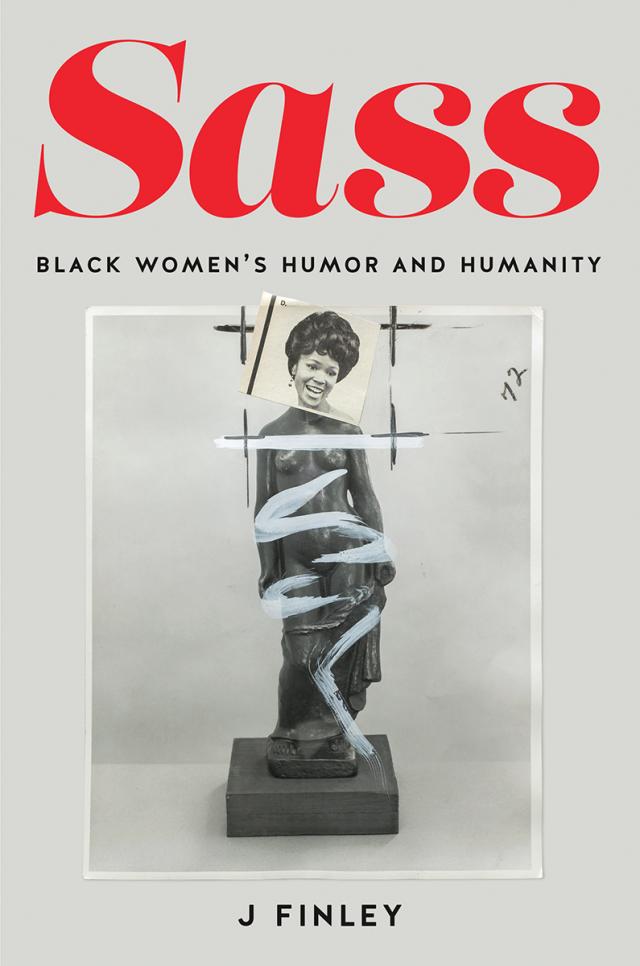
Cover art: Lorna Simpson, Famous Statue, 2013. Found photograph and collage on paper, 29½ × 21⅝ in. (74.9 × 54.9 cm); framed: 31 × 24 × 1⅝ in. (78.6 × 61.1 × 4.1 cm). © Lorna Simpson. Courtesy of the artist and Hauser & Wirth; photograph by James Wang.
Library of Congress Cataloging-in-Publication Data
Names: Finley, J, author.
Title: Sass : Black women’s humor and humanity / J Finley.
Other titles: Black women’s humor and humanity | MF! Momentary futures in Black studies.
Description: Chapel Hill : The University of North Carolina Press, 2024. | Series: MF! Momentary futures in Black studies | Includes bibliographical references and index.
Identifiers: LCCN 2024005604 | ISBN 9781469680026 (paperback ; alk. paper) | ISBN 9781469680019 (cloth ; alk. paper) | ISBN 9781469680033 (ebook) | ISBN 9781469682150 (pdf)
Subjects: LCSH: African American women comedians. | African American women—Social life and customs. | African American wit and humor. | Comedy—Political aspects.
Classification: LCC E185.86 .F524 2024 | DDC 305.48/896073—dc23/eng/20240304
LC record available at https://lccn.loc.gov/2024005604
Portions of chapters 1, 2, 4, and 5 appeared earlier, in somewhat different form, in, respectively, Jessyka Finley, “Black Women’s Satire as (Black) Postmodern Performance,” Studies in American Humor 2 (4) (2016): 236–65, https://doi.org/10.5325/studamerhumor.2.2.0236; Jessyka Finley, “Raunch and Redress: Interrogating Pleasure in Black Women’s Stand-up Comedy,” Journal of Popular Culture 49 (4) (August 2016): 780–98 (© 2016 Wiley Periodicals, Inc.); Jessyka Finley, “From Awkward to Dope: Black Women Comics in the Alternative Comedy Scene,” in The Joke Is on Us: Political Comedy in (Late) Neoliberal Times, edited by Julie A. Webber (Lanham, MD: Lexington, 2019); and Jessyka Finley, “Irreverence Rules: The Politics of Authenticity and the Carnivalesque Aesthetic in Black South African Women’s Stand-Up Comedy,” Journal of Aesthetics and Art Criticism 78 (4) (September 2020): 437–50 (used by permission of Oxford University Press).
For my children, Desmond and Inge
CONTENTS
ACKNOWLEDGMENTS
INTRODUCTION
Cut-Eye and Suck-Teeth: Theorizing Black Women’s Sass as a Discourse Genre
CHAPTER 1
Never to Be Conquered: Sass, Subjection, and Black Women Self-Possessed
CHAPTER 2
Hard-Core Laughter: Sass and the Politics of Raunch
CHAPTER 3
Butch Lives Matter: Sass, Masculinity, and Failure
CHAPTER 4
From Awkward to Dope: Sass, Interiority, and Black Women’s Alternative Comedy
CHAPTER 5
Irreverence Rules: Sass and Diaspora Culture
CODA
You Don’t Quit, Bitch, Unless You Wanna Quit
NOTES
BIBLIOGRAPHY
INDEX
ILLUSTRATIONS
Jada Pinkett Smith at the 94th Academy Awards
Cardi B’s November 2020 Instagram post
Michelle Obama at the 2013 Inauguration Day luncheon
Jackie “Moms” Mabley in men’s clothing
Jackie “Moms” Mabley performing in character
The author performing stand-up
Gladys Bentley
ACKNOWLEDGMENTS
T
his book has humbled me, and I’m grateful for the compassion, guidance, and expertise of the many people who have helped me bring what was a dream to reality. Thank you, Mama, for bringing me into the world and passing on to me the love of books and the gift of curiosity. To my family, who has always encouraged and supported me (and chin-checked me when necessary), thank you for everything. A special shout-out goes to Aunt Arlene, Aunt Dee, Uncle Blue, Aunt Bibby, and all my cousins. I miss my grandma Mary Murphy and the stories she told over and over. Thanks, Grandma, for all your love and the history you passed on. The first person I ever remember laughing with was my brother, Jeremy Finley. I miss him every day, and my sense of humor is colored by growing up with his silly ass. He’s not here, but he’s here. So is his son Dariyan, who made me the auntie I am today. And Noah, my little boo, I see you and I love you. Special thanks go to my Cook family, Joyce, Bruce, and Lizzie, for believing in me and supporting me through this long process.
This project would be nothing without the comics who generously shared their insight, knowledge, and history with me, and I am profoundly grateful to the comics and Black comedy stewards who have contributed to this work. Specifically, I would like to thank Karinda Dobbins, Hope Flood, Kamane Malvo Marshall, Khristee Rich, Aisha Tyler, the late Paul Mooney, Luenell, Laura Hayes, Vanessa Chambers, Niroma Johnson, Jennifer Weeks, the late Jane Galvin-Lewis, Thea Vidale, Naomi Ekperigin, Calise Hawkins, and Gina Yashere. I would also like to thank Ayoka Chenzira and Debra Robinson for kindly providing copies of their films. Michael Williams shared a wealth of knowledge about Black comedy, and I appreciate his kindness and support.
There were many times when I did not believe in this project, and my editor, Dawn Durante, never faltered in her encouragement and support. I am so blessed to have found an editor who believed in this book, who understood and cared about what I have been trying to say, and who graciously ushered me through this process like the boss she is. Thanks, Dawn, Carol Seigler, and the editorial staff at the University of North Carolina Press for your support and guidance through this process, along with the anonymous reviewers whose generous and candid feedback has enhanced the quality of this book. I also want to thank L. H. Stallings for being an inimitable model for beautiful, no-nonsense writing and for the extensive advice and suggestions for revisions that have made this a better book.
Call the building whatever you want at UC Berkeley, but the sixth floor is the sixth floor when it comes to the Department of African American and African Diaspora Studies, and that place made me; it’s the place where the words and ideas in this book were born. Thank you to all the professors, staff, and mentors on the sixth floor who have inspired me, pushed me, believed in me, and literally paid my bills—especially Lindsey Villareal, Brandi Wilkins Catanese, Leigh Raiford, the late Vévé Clark, Robert L. Allen, and Charles Henry. I’m grateful for the place that will always feel like home. Catherine Cole is a force and a wonderful advocate—thank you for the entry into ethnography, which continues to shape the work I do. A shout-out goes too to the homies and colleagues I spent so much time learning and growing with on the sixth floor—Jasmine Johnson, Michael McGee, Gabrielle Williams, Malika Crutchfield, the late Carmen Mitchell, Ronald Williams II, Lia Bascomb, Ameer Hassan Loggins, Ianna Hawkins Owen, Katherine Benjamin, Shaun Osei-Owusu, Zach Manditch-Prottas, and Chris Petrella.
I remember the first time I encountered Ula Taylor’s work as an undergraduate student, working on an essay about Black womanhood and the politics of respectability. Ever since I read her book, her words have inspired me, and I could not believe my good fortune in 2006 when I learned I would have the chance to be her student in grad school. The first time I worked closely with Ula was in the fall of 2009 when we took on an independent study together on Black women’s humor. She was no expert on the topic, she informed me, but she was undaunted and enthusiastic. We chose and read the texts together, each week discovering exciting lines of inquiry and archives untapped. It was during this independent study that I began to understand how archives work, and slowly, the process of conducting research and crafting interesting and critical intellectual questions was demystified. It was difficult work that Ula guided me through, challenging me week after week not only to answer questions about Black women’s humor but also to craft them, redraft them, and constantly sharpen my analytical lens. Ula is one of one, someone who has shown me through example what it means to be original, to be creative, and to embrace my scholarly voice. She has also been there in my very lowest moments with warmth, grace, and her precious time. Thanks for everything, Ula; I hope this work makes you proud.
This work was generously funded by the Andrew Mellon Foundation while I was a postdoctoral fellow at Middlebury College, support for which I am deeply appreciative. My colleagues and friends at Middlebury have been instrumental in my growth as a scholar and teacher, and I am especially grateful for American studies people Holly Allen, Susan Burch, Deb Evans, Ellery Foutch, Rachael Joo, Will Nash, and Michael Newbury. I appreciate each of you for making space for me in the program to come into my own, and your comments on my work through the years have made such a positive impact. So much love and thanks go to Rachael Joo, who has been one of my main advocates, a writing partner, and a great friend! Special and heartfelt gratitude goes to Laurie Essig in Gender, Sexuality, and Feminist Studies too—I appreciate your early comments on my work and ongoing encouragement. I also want to thank the homies at Middlebury, Carly Thomsen, Jenn Ortegren, Jason Vrooman, Alvin Henry, and Matt Lawrence, who have made me laugh, made me food, and made me grateful for the seven years I spent in the Green Mountain State.
Moving across the country during the pandemic was a struggle. A special shout-out and love go to Prageeta Sharma, Amanda Lagji, Diana Linden, Peter Ross, Emily and Alex Linden-Ross, whose friendship in that transition has made my life more joyful and fun. And thanks go to Ted Hekman for helping me with the images for the book.
Over the past decade I have had the privilege and great fortune of working with some incredible undergraduate students whose careful attention to detail as research assistants has not only lightened my load but also fundamentally contributed to the arguments I present in this book. Thank you, Addie Mahdavi, Amanda Oluwatosin Eric, and Saténa Charles-Luciani, for your curiosity, consistency, and dedication. I appreciate each of you very much and the work you’ve helped me accomplish—I’ll take all the credit though, for all mistakes, misreading, or errors otherwise.
It has been an honor and pleasure to work with my colleagues at the American Humor Studies Association. I want to thank Beck Krefting specifically for organizing the First Book Workshop, where I got so many valuable resources and strategic information about book publishing—game changer!
My students have been instrumental in sharpening the way I think about humor and comedy, and my classes have been the incubator for a lot of the thoughts I commit to the page. I want to thank my students at Middlebury and Pomona in the classes Black Comic Cultures, Black Queer (After)Lives, and Black Womanhood in Popular Culture for keeping me on my toes, helping me keep my ideas fresh, and not letting me off the hook—working with you all has been a privilege and pleasure, and you all have helped me make this a sharper book.
To my A-1 day ones, my friends who have been here before I was J, when I was just Jessyka—Rosemary Sims, Ashley Jackson, Andrea Aikin—thank you all for holding me up, holding me down, crying with me, laughing so hard we cried together, thank you. We’ve been through so much together, and I am incredibly grateful to be sliding through life with y’all. ;) To my friends whom I met in the transition from Jessyka to J—Jon Sribnick, M’issa Fleming, Lexie Bouwsma, Aran Jones, Jeena Zografos, and Pepe Lopez—thank you for always letting me be myself.
In this game (of life . . . ), everybody needs a good therapist. Lindsay Jernigan, my therapist, walked with me through the good, the bad, and the ugly with such grace and kindness that I learned how to show myself those qualities, too. This book is a testament to it, because in the darkest moments when I could not see where I was going, she showed me that I can be my own light.
Toni Cook is my hand-holder, my laugh maker, my joke writing partner, my joke making partner, my tear catcher, my line reader, my baby mama, my love. “Thank you” doesn’t capture the gratitude I feel for you and all you do for me. You’ve been here right from the start, taking on all kinds of roles, whatever’s necessary at the time. I appreciate and love you with all I have, and I hope you’re proud of me. My babies, Dez and Inge, thank you for making me a mama. All this is for you.
SASS
INTRODUCTION CUT-EYE AND SUCK-TEETH: THEORIZING BLACK WOMEN’S SASS AS A DISCOURSE GENRE
Sassy conduct is itself a strategy for resisting social devaluation.
—JOYCE WEST STEVENS, Smart and Sassy
T
he smile slowly faded from Jada Pinkett Smith’s face at the 94th Academy Awards on March 27, 2022. She was seated in the front row next to her husband, Will Smith, who had been nominated for Best Actor for his role in the film King Richard. She clasped her hands tightly in her lap and sent a sharp cut-eye toward the Oscars’ host, comedian Chris Rock, who had just told a joke at her expense. “Jada, I love ya [pointing down to her]. GI Jane 2, can’t wait to see it, aight?!” Pinkett Smith was wearing a close-cropped natural, nearly bald that night owing to her alopecia. She had publicly spoken about her struggle with the autoimmune disorder and its physical and emotional effects. A few days before she sat at the Academy Awards ceremony and became the target of Chris Rock’s joke, she had uploaded a video to TikTok explaining to her following that she had come to terms with her shorn hair after years of ambivalence and Hollywood expectations of Black feminine propriety.
I always had to do my hair in ways that didn’t feel natural to me, because I was trying to play the game. So, if I’m doing a [magazine] cover, everybody’s [like], “No, we want your hair straight, flowy.” I’m like, “All right, cool. . . . But that’s not what my hair likes to do. [Laughs to self.] So, I had to get the courage to just go, “Nah, I’m not doing that.” Which is why I feel the freedom today. I don’t give two craps what people feel about this bald head of mine. ’Cause guess what [pointing to herself with both thumbs]? I love it.1
The crowd at the Academy Awards was laughing with Chris Rock, including her husband, Will Smith, and actress Lupita Nyong’o, who were shown on camera directly after the insulting joke. Pinkett Smith tightened her posture and rolled her eyes, registering at the very least her displeasure at publicly becoming the butt of a joke, especially in what could be read as an ad hominem attack on her seeming failure to meet Hollywood standards of femininity, based on Rock’s reference to the film GI Jane. As Marlon M. Bailey and Matt Richardson have noted, “Gender performance has tremendous material consequences, as it is meticulously scrutinized and assiduously policed, and those who do not follow the logic of heterogender are often subject to violence and death.”2 Pinkett Smith was relegated by Rock to the category of unwoman, a distinction particular to Black women since the period of enslavement, facing constant defeminization in popular culture, in “scientific” analyses, in political discourse, and in everyday life to the effect of shaming their sexual practices, devaluing and exploiting their bodies, silencing their critiques of power, and rendering them objects of comedic ridicule.
When Chris Rock publicly derided Jada Pinkett Smith, her reaction—to cut her eyes and create distance between herself and the object of her sass—reverberated across time and space. It reached back to enslaved women, to sharecropping women, to Black women like Shirley Chisholm, Kamala Harris, and now Ketanji Brown Jackson who share the distinction of being “firsts.” All along, Black women have endured dehumanization through gritted teeth, empowered by the ingenuity of spirit and the exigency of their circumstances to deflect insult and injury. Sass has been a powerful agent of deflection and humanization in a world that sees and often treats Black women as perennial punching bags and scapegoats, bearing the brunt of white supremacist, patriarchal power.3
Jada Pinkett Smith reacts to a joke at her expense at the 94th Academy Awards, March 27, 2022. Screenshot by author from The Daily Mail, clip courtesy A.M.P.A.S. © 2022, www.dailymail.co.uk/tvshowbiz/article-10658717/Oscars-2022-Smith-Chris-Rock-Jada-Pinkett-Smith-row-moment-moment.html. Will Smith stood up, walked onto the stage, and ceremoniously slapped the shit out of Chris Rock before returning to his seat in the stunned audience. “Keep my wife’s name out your fucking mouth,” Smith roared twice before Rock—shook and nearly speechless—moved on to present the next award. This became the story. Debates swirled. Did Rock deserve it? Did Smith go too far? Did this incident further sully Black people’s already battered public image? Was Smith protecting Black women appropriately? Can comedians go too far? Is comedy dead? These are all valid questions, but they are for someone else to answer. What struck me is the way Jada Pinkett Smith’s response to the joke was usurped and elided by her husband’s bid to publicly claim and assert his fragile, patriarchal masculinity. Pinkett Smith had said she felt free a few days before the Oscars. What that freedom meant was that she no longer had to hold on to other people’s ideas about who she should be, what she should look like, and how she should act. Indeed, she had moved beyond mere acceptance of her difference in terms of how she presented her femininity; she had transcended feelings of ambivalence and moved to the side of loving herself—the ultimate individual enactment of Black feminist politics that could set the very foundation for collective action. “I don’t give two craps what people feel about this bald head of mine. ’Cause guess what? I love it.”






