Before she kills, p.1
Before She Kills, page 1


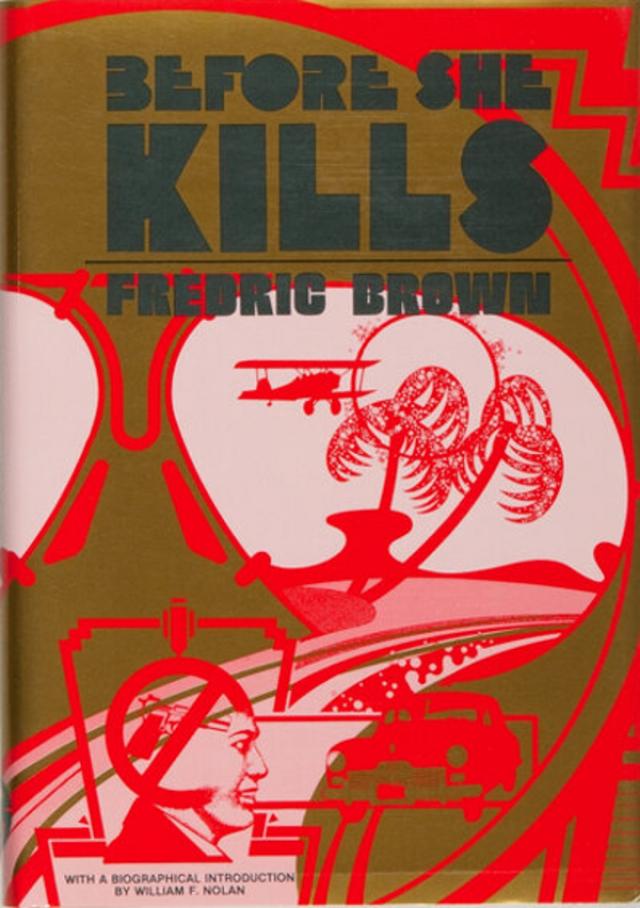
BEFORE SHE KILLS
FREDRIC BROWN
In the
Detective Pulps
Volume 2
With a biographical introduvtion by
William F. Nolan
ACKNOWLEDGEMENTS
“Introduction,” copyright © 1984 by William F. Nolan.
“Before She Kills,” Ed McBain's Mystery Magazine No. 3, copyright © 1961 by Pocket Books, Inc.
“The Missing Actor,” The Saint Detective Magazine, November 1963, copyright © 1963 by King Size Publications, Inc.
“Mad Dog!” Detective Book Magazine, Spring 1942, copyright © 1942, by Love Romances Publishing Co.
“A Date To Die,” Strange Detective Mysteries, July 1942, copyright © 1942, copyright renewed 1970, by Popular Publications.
“A Cat Walks,” Detective Story Magazine, April 1942, copyright © 1942, by Street & Smith Publications, Inc.
“Handbook for Homicide,” Detective Tales, March 1942, copyright © 1942, copyright renewed 1970, by Popular Publications, Inc.
This first edition of Before She Kills
by Fredric Brown is limited to 350 copies,
each of which is signed and numbered by
the author of the introduction
William F. Nolan. This copy #__________
before she kills
(collection)© 1984 by Elizabeth C. Brown.
All rights reserved.
Cover design by William L. McMillan
First paperback edition published December 1986
Dennis McMillan Publications
1995 Calais Dr. No. 3
Miami Beach, FL 33141
Contents
ACKNOWLEDGEMENTS
INTRODUCTION FRED BROWN REMEMBERED ~ William F. Nolan
A DATE TO DIE
MAD DOG!
HANDBOOK FOR HOMICIDE The Road to Einar
The Thud of Murder
The Murderer's Guide
Seven Times Death
A Toast to Fear
Design for Dying
Death Before Dawn
The Last Battle
BEFORE SHE KILLS 1
2
3
4
5
6
7
8
9
10
A CAT WALKS
THE MISSING ACTOR
INTRODUCTION
FRED BROWN REMEMBERED
by
William F. Nolan
A snapshot represents a fragment of frozen time––a way station along the cosmic timestream. The camera records a particular moment of life, capturing it totally, as a fly is caught in amber. Later, that photograph becomes a time machine, taking us back to a precise moment and place, allowing us readmittance to the past. Old memories, lost emotions, are activated.
Case in point: a snapshot on the desk in front of me, dating back to the summer of 1952. Here we all are: me, Fred Brown, Bill Gault and Cleve Cartmill, captured by the lens––Fred, pale, pensive and elfin behind steel-rimmed glasses, with his characteristic wisp of moustache; Gault, solid and tough in an open-neck sport shirt; Cartmill, wry, half-smiling, hands folded over a cane (polio had crippled him early in life); and me, standing to one side, lean, gawky, nervous.
Back then, in that Time of the Snapshot, more than three lost decades ago, we were all living in Southern California. Fred and Bill and Cleve were poker-playing drinking buddies, veteran fellow professionals with a multitude of impressive pulp and slick credits; I was a raw 24-year-old, two years away from my first professional magazine appearance, desperately anxious for a writing career of my own. I looked upon these seasoned pros with awe, respect and envy.
Fred was then in the process of helping launch Gault's book career. Don't Cry for Me (1952) was William Campbell Gault's first published novel, issued from Brown's regular publisher, E.P. Dutton, with a generous blurb from Fred on the jacket, praising author and novel.
The gesture was typical. Fred also encouraged me in my early work, openly sharing his knowledge and skills. I found him to be a warm, quiet man with a wacky, pun-loving sense of humor, a sideways thinker who did all of his rough-draft writing inside his head. (His work needed little or no revision from first typescript to printed page.)
He had a special love for music. I'd purchased a new tape recorder that year and I still have a tape of Fred playing his Chinese flute. He had lived in the small town of Taos, New Mexico, before coming to California, and told me that he was “the finest flute player in Taos,” adding, with a sly mouse-grin, “that's because no one else in town played a flute.”
Fredric William Brown was born, an only child, in Cincinnati, Ohio, in late October of 1906. Fred's mother died of cancer when he was fourteen. His father, a newspaper man, also died when Fred was in his early teens. On his own, in 1922, he obtained a job as office boy with a machine tool company in Cincinnati, Conger & Way, working there into 1924. (He used this background for his autobiographical novel, The Office, published in 1959.)
Fred also worked with a traveling carnival during this early period, sharing a tent with the show's mind reader. “I soaked up the atmosphere twenty-four hours a day,” he stated in a note for his carny novel, Madball (1953), “and it's still in my system.” (A carnival theme appeared in many of his tales.)
At twenty, Fred enrolled at Hanover College in Indiana, but spent less than a full year there. He married Helen Brown (no relation) in 1929––and began a 17-year career as a proofreader in Milwaukee in 1930. (I have always found this highly ironic, since Fred's first name was constantly misprinted during his career––as Frederic, Frederick, Fredrick, Fredrik, etc. In fact, years after his death, when I included Fred on the dedication page of my novel, Logan's World, a copy editor at Bantam decided that I had not spelled his name correctly, and changed it to “Frederic” on the final galley.)
Proofreading, of course, was never his choice; in his boyhood, Fred had been inspired by Wells, Verne, Burroughs and Jack London, and had formed the dream of becoming a professional writer. Dream became reality in 1938 when he sold his first story to a crime pulp magazine. He began churning out a wide variety of fiction tales for the pulp markets, but could not earn enough at pulp rates to support his wife and two sons. His job as a proofreader helped pay the bills.
Fred attempted to enter the book field in the 1940s, but when his first novel, The Fabulous Clipjoint, was rejected by twelve publishers he decided that he had “absolutely no future as a novelist.” Then Dutton took a chance and published the book in 1947. By the following year, Fred was in New York accepting the “Edgar” for Best First Novel from the Mystery Writers of America. Dutton's gamble had paid off; they wanted more Fredric Brown mysteries. Fred was forty-one.
“That was the real beginning of my career as a writer,” he told me. “With the success of Clipjoint, I was able to quit my proofreader's job with the Milwaukee Journal and write fulltime.”
Fred was divorced the year his book was printed; in 1948 he married Elizabeth Charlier after they'd met at a writers' gathering. They moved to Taos the following year.
“We moved there because of Fred's health,” Beth told me. “He suffered from asthma all his life, and needed clear air. We stayed in Taos into the early 1950s.”
In New Mexico, Fred took up watercolor painting as a hobby (along with chess, golf and his flute). He wrote and painted at a studio in the historic Governor Bent House in Taos. (“This was the room in which the first American governor of New Mexico was scalped and assassinated in 1848––which provided the perfect climate for my crime fiction.”)
By 1952 the Browns had moved to Venice, California (Ray Bradbury's early stomping ground; I'd met Ray there in 1950). Smog was really not a problem in those days, and the ocean breeze kept the air cleared. As co-chairman of the 1952 Westercon (held at the U.S. Grant Hotel in downtown San Diego), I invited Fred to attend as one of the science fiction professionals, along with Bradbury, Cartmill, Kuttner, Neville, Van Vogt, Boucher and others. Fred was “a two-sided writer,” equally as well known for his sf work as for his mysteries. He very much enjoyed working in both genres.
I recall him at the convention that year––a shy, small, self-effacing man who hated being “in the limelight.” But he did favor the company of fellow pros, and appreciated being part of the festivities.
We became fast friends after that convention weekend. We talked a lot about the special problems of plotting, and I recall that he startled me by revealing his offbeat plot method. “I have to do at least one new mystery novel a year for Dutton,” he told me. “As each annual deadline nears I become more and more certain I can never come up with another decent mystery plot. So I buy a cross-country bus ticket for a round trip to some distant city, ride there and back, thinking only about the novel.”
He'd always arrive back in California with a full plot worked out in his head. Then he'd sit down and write it.
By 1954 Fred and Beth had left the Los Angeles area to live in Tucson, Arizona. Again, for reasons of health. I was sorry to see him go––but we maintained a warm correspondence and he was very supportive as my own pro career got rolling in the mid 1950s.
We met again in 1961. Fred invited me to have lunch with him in Hollywood. He had come to Los Angeles to write television scripts for the Hitchcock show––and to sell his sf novel, The Mind Thing, as a feature film. (The film never jelled, but he did write some teleplays.)
I remember that his hands were shaking. He was fifty-fiv e, thinner than ever, and quite fragile. He told me that he really liked Southern California, but could no longer live in the area: “The smog is murder on my bum lungs.”
He returned to Tucson.
By the close of 1963, suffering from emphysema, he could no longer write books; his last mystery novel was printed that year.
Fred knew that his career was over. In September of 1971 he confessed in a letter: “Been quite a while since I've done any important creative work.”
His condition was terminal. On March 12, 1972, at the age of sixty-five, Fred died of emphysema in Tucson.
What, exactly, did he accomplish in his two dozen active years as a writer? Statistically, we have 28 published novels and several collections encompassing the best of his 270-odd short stories and novelettes (printed in more than 60 magazines, pulp and slick). He completed 22 mystery novels, and these include some of the finest character-suspense studies in the genre. The Screaming Mimi has always been one of my personal favorites and his sf novel, What Mad Universe, is a true classic. It remains unique: chilling, funny, fast-paced, endlessly inventive. Hallmarks of all his best fiction.
In my Brown collection, I prize a first edition of his boldly-experimental crime tale, Here Comes a Candle (“. . . to light you to bed. Here comes a chopper to chop off your head!”) A stylistic tour de force, the book is written in the form of news clips, straight narrative, radio-play form, as a screenplay, a sportscast, TV script and stage play! And, by God, Fred pulls it off beautifully. A real stunner.
Fred Brown's work reflected the gentle toughness of the man himself, along with his fears, his delight in the bizarre and offbeat, his concern for creating real people in real worlds (and that included his science fictional worlds!); you care about his characters because Fred cared about them.
I have no intention of talking about the stories in this collection; I'm going to allow you to discover the joy in each of them for yourself.
Suffice to say that my old pal, Fred, is alive once again in these pages––with his sly humor, his wickedly-accurate eye for detail, his ability to enchant, shock and surprise.
Believe me, you'll enjoy knowing him.
W.F.N.
May, 1984
Agoura, California
A DATE TO DIE
It was five minutes before five a.m. and the lights in my office at the fourth precinct station were beginning to grow gray with the dawn. To me, that's always the spookiest, least pleasant time of all. Darkness is better, or daylight. And those last five minutes before my relief are always the slowest.
In five minutes Captain Burke would arrive––on the dot, as always––and I could leave. Meanwhile, the hands of the electric clock just crawled.
The ache in my jaw crawled with them. That tooth had started aching three hours ago, and it had kept getting worse ever since. And I wouldn't be able to find a dentist in his office until nine, which was four long hours away. But, come five o'clock, I'd go off duty, and I had a pretty good idea how to deaden the pain a bit while I waited.
Four minutes of five, the phone rang.
“Fourth Precinct,” I said, “Sergeant Murray.”
“Oh, it's you, Sergeant!” The voice sounded familiar, although I couldn't place it; it was a voice that sounded like an eel feels. “Nice morning, isn't it, Sergeant?”
“Yeah,” I growled.
“Of course,” said the voice. “Haven't you looked out the window at the pale gray glory that precedes the rising of––”
“Can it,” I said. “Who is this?”
“Your friend Sibi Barranya, Sergeant.”
I recognized the voice then. It didn't make me any happier to recognize it, because he'd been lying like a rug when he called himself my friend. He definitely wasn't. On the blotter, this mug Barranya is listed as a fortune-teller. He doesn't call himself that; when they play for big dough, the hocus-pocus boys call themselves mystics. That's what Barranya called himself, a mystic. We hadn't been able to pin anything on him, yet.
I said, “So what?”
“I wish to report a murder, Sergeant.” His voice sounded slightly bored: you'd have thought I was a waiter and he was ordering lunch. “Your department deals in such matters, I believe.”
I knew it was a gag, but I pressed the button that turned on the little yellow light down at the telephone company's switchboard.
I'll explain about that light. A police station gets lots of calls that they have to trace. An excited dame will pick up the phone and say “Help, Police” and bat the receiver back on the hook without bothering to mention who she is or where she lives. Stuff like that. So all calls to any police station in our city go through a special switchboard at the phone station, and the girl who's on that board has special instructions. She never breaks a connection until the receiver has been hung up at the police end of the call, whether the person calling the station hangs up or not. And there's that light that flashes on over her switchboard when we press the button. It's her signal to start tracing a call as quickly as possible.
While I pressed that button, I said, “Nice of you to think of me, Barranya. Who's been murdered?”
“No one, yet, Sergeant. It's murder yet to come. Thought I'd let you in on it.”
I grunted. “Picked out who you're going to murder yet, or are you going to shoot at random?”
“Randall,” he said, “not random. Charlie Randall, Sergeant. Neighbor of mine; I believe you know him.”
Well––on the chance that he was telling the truth and was going to commit a murder––I'd as soon have had him pick Randall as anyone. Randall, like Barranya, was a guy we should have put behind bars, except that we had nothing to go on. Randall ran pinball games, which isn't illegal, but we knew (and couldn't prove) some of his methods of squelching opposition. They weren't nice.
Barranya and Randall lived in the same swank apartment building, and it was rumored that the pinball operator was Barranya's chief customer.
All that went through my head, and a lot of other things. Telling it this way, it may sound like I'd been talking over the phone a long time, but actually it had been maybe thirty seconds since I picked up the receiver.
Meanwhile, I had the receiver off the hook of the other phone on my desk––the interoffice one––and was punching the button on its base that would give me the squad car dispatcher at the main station.
I asked Barranya, “Where are you?”
“At Charlie Randall's,” he said, “well, here it goes, Sergeant!”
There was the sound of a shot, and then the click of the phone being hung up.
I kept the receiver of that phone to my ear waiting for Central to finish tracing the call, which she'd do right away now that the call had been terminated at that end. Into the other phone I said, “Are you there, Hank?” and the squad car dispatcher said, “Yeah,” and I said, “Better put on the radio to–– Wait a second.”
The other receiver was talking into my other ear now. The gal at Central was saying, “That call came from Woodburn 3480. It's listed as Charles B. Randall, Apart––”
I didn't listen to the rest of it. I knew the apartment number and address. And if it was really Charlie Randall's phone that the call had come over, maybe then Barranya was really telling the truth.
“Hank,” I said, “send the nearest car to Randall's apartment, number four at the Deauville Arms. It might be murder.”
I clicked the connection to the homicide department, also down at main, and got Captain Holding.
“There might be a murder at number four at the Deauville,” I reported. “Charlie Randall. It might be a gag, too. There's a call going out to the nearest squad car; you can wait till they report or start over sooner.”