

Blood before dawn, p.1
Blood Before Dawn, page 1
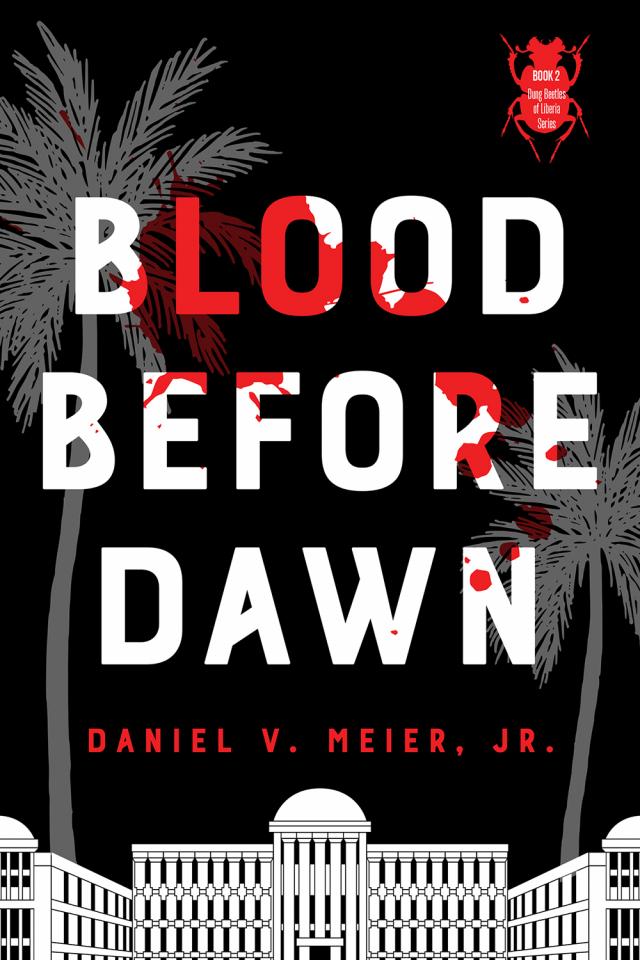


Blood Before Dawn, Book 2 in The Dung Beetles of Liberia series
© 2021 Daniel V. Meier, Jr. All rights reserved.
No part of this book may be reproduced in any form or by any means, electronic, mechanical, digital, photocopying, or recording, except for the inclusion in a review, without permission in writing from the publisher.
While the story is based on real events, this is a work of fiction. All of the characters, names, incidents, organizations, and dialogue in this novel are either the products of the author’s imagination or are used fictitiously.
Published in the United States by BQB Publishing
(an imprint of Boutique of Quality Books Publishing, Inc.)
www.bqbpublishing.com
Printed in the United States of America
978-1-952782-35-0 (p)
978-1-952782-36-7 (e)
Library of Congress Control Number: 2021948707
Book design by Robin Krauss, www.bookformatters.com
Cover design by Rebecca Lown, www.rebeccalowndesign.com
Map illustrator: Rosana Keleber
First editor: Caleb Guard
Second editor: Andrea Vande Vorde
PRAISE FOR BLOOD BEFORE DAWN AND AUTHOR DANIEL V. MEIER, JR.
“Meier continues his The Dung Beetles of Liberia series with this enthralling installment as Ken Verrier returns to Liberia to buy diamonds. It’s April of 1979. When Ken, accompanied by his strong-willed wife, Sam, planned to return to Liberia to buy diamonds, he had no idea the country was entering a devastatingly tumultuous period of political unrest. Will he get out alive? Meier’s insights into the ways corruption, injustice, and atrocities hollow out a nation’s soul are cleareyed. His prose is intelligent, the narrative engrossing, and his unflinching forays into the African nation’s social, cultural, and political atmosphere are realistic. Along the way, he weaves in a high-profile assassination, suspense, and daring escapades, keeping readers invested. From its adrenaline-fueled opening to its surprising conclusion, this poignant novel brilliantly captures the population’s unrest and the white-hot fury as they struggle to obtain the basic necessities of life. This is a powerful story of civil unrest, corruption, and the arbitrary division between the masses.
— The Prairies Book Review
“. . . In both books, The Dung Beetles of Liberia and this sequel, Blood Before Dawn, author Daniel V. Meier, Jr. captures the essence of Africa. It’s a continent that is both majestic and undeniably cruel. It’s the battlefield where the clash between foreign influence with western ideals of life and a fair standard of living, tribalism, lack of compassion, minimal sanctity of life, and belief in witchcraft meet and struggle. Meier throws the Americans into this mix, who are worried that either China or Russia is gaining inroads into an area they wish to influence, and this lights the touch paper to the revolution. No one is safe; men’s basest behaviors are unleashed, destroying lives and livelihoods. . . . The story itself takes the reader on a page-turning, fast-moving exciting ride, and I found myself holding my breath as I flew through the chapters . . . this is another read that will stay with me for years to come.”
— Lucinda E. Clarke for Readers’ Favorite reviews
“. . . Daniel V. Meier, Jr. has written another compelling historical fiction narrative in Blood Before Dawn. Readers hit the ground running in the beginning scenes (along with the main characters, much to their horror) while the suspenseful and harrowing story of the corrupt political environment and unrest in Liberia unfolds and doesn’t subside until the shockingly messy conclusion.
It is evident that the author is a master of writing in the historical fiction genre, whether he is spinning a tale partly from his personal experience as seen in this series, or with his other equally engaging historical fiction works. Readers are not just told a wild, fictional story that might have some basis in history, but they’re presented with an entertaining story expertly woven throughout real events in the tumultuous history of Liberia. . . . Blood Before Dawn. . . will not only linger in your thoughts, but it also has the potential to awaken your thirst for knowledge.”
— Lynette Latzko, Feathered Quill Book Reviews
TABLE OF CONTENTS
Chapter 1 April 1979
Chapter 2 Winston
Chapter 3 BAO
Chapter 4 “Mining Engineers”
Chapter 5 The Clandestine Service
Chapter 6 Wiesua
Chapter 7 The Meeting
Chapter 8 Honorable Williams
Chapter 9 The Opposition
Chapter 10 West African Air Services
Chapter 11 The Armed Forces of Liberia
Chapter 12 The Big Meeting
Chapter 13 Military Secrets
Chapter 14 All The Proof You Need
Chapter 15 In Too Deep
Chapter 16 “One Picture is Worth a Thousand Words”
Chapter 17 Guns
Chapter 18 Stephens & Coe & Co.
Chapter 19 Trevor
Chapter 20 ARS-57
Chapter 21 Precautions Taken
Chapter 22 The Fishing Trip
Chapter 23 Skru Up
Chapter 24 Voinjama
Chapter 25 Binji
Chapter 26 Mr. Chao
Chapter 27 Adoption or Bondage?
Chapter 28 A Sense of Honor
Chapter 29 We Must Move On to Our Destiny
Chapter 30 Tolbert and PAL
Chapter 31 Piers
Chapter 32 The Debriefing
Chapter 33 PAL Demonstration
Chapter 34 Repercussions
Chapter 35 Two Days Before April 12, 1980
Chapter 36 April 12, 1980
Chapter 37 Betrayal
Chapter 38 Monrovia Burning
Chapter 39 The Other Woman
Chapter 40 Mission Accomplished
Chapter 41 Kangaroo Court
Chapter 42 Escape
Chapter 43 Freetown
Chapter 44 Home
About the Author
Other Books by Daniel V. Meier, Jr.
ACKNOWLEDGMENT
To Caleb Guard, my editor, for his patience, understanding and professionalism and to Andrea Vande Vorde for her eye for detail.
I would also like to thank Jane Knuth of the The Knuth Agency for being a particularly thoughtful early reader and editor and to Teeja Meier, my wife, for her faith in me and for her love.
CHAPTER 1
APRIL 1979
I’d always known that one could get into trouble just standing on a street corner, but never like this. We had just finished a late breakfast at a new Lebanese restaurant on Gurley Street in center city Monrovia, and were actually standing on the corner of Gurley and Benson when a crowd—more of a roaring mob—swept down the street like a tidal bore. Judging from the signs and posters coming toward us, the throng seemed to be heading in the direction of the Executive Mansion. We watched for a moment, fascinated, just as one might stare at a growing flood, then realized, too late, that we were caught up in this human deluge. We tried to run, but we were already submerged in the tumbling waters of human flesh and the roar of human voices.
Sam and I glanced at each other. “What the hell?” All we could do was lock arms and flow with the mob.
I had returned to Liberia because I needed to raise a lot of cash quickly, and the best way I could do that was to drop in on some of my old friends in the diamond business. It was the beginning of the wet season in West Africa—not the best time to arrive or, in fact, to do anything there. My wife, Sam, had insisted on coming with me. I told her I didn’t think it was a good idea—Sam is one of the toughest people I know. You just don’t say no to her, not even a maybe. Then, too, I knew she was better at this sort of thing than I was.
It had been twelve years since Sam and I were in Africa, but Sam appeared not to have aged a single day. She still had the same thick red hair that she had cut short for the trip. It would be easier to manage in the heat and humidity of Liberia. Her eyes were still clear and green with the same laugh wrinkles at the corners, and the attractive bridge of freckles across her nose and upper cheeks had not faded. I knew that with her intelligence and insight we had a much better chance of succeeding.
The flights to Liberia had been long and arduous despite Pan Am’s latest jet transport airplanes. Sam and I learned a new term on this trip: “jet lag.” We experienced it by first falling asleep during the taxi ride to the Ambassador Hotel. Then, after a surreal check-in at the hotel, we went up to our room in a dreamlike state and, without removing our clothes or taking a shower or any of the normal things people do before retiring for the night, collapsed onto the bed and immediately fell deeply asleep until early the next morning when our unexpected adventure began.
The noisy mob, brandishing posters reading, “OUT WITH TOLBERT!”, “STOP OPPRESSION NOW!”, “WE WANT RICE!” swept us up into their superheated mist and carried us along like two pieces of entwined flotsam. We tried but could not move against the flow. Sam and I began to move laterally through the crowd like two small animals trying to swim across a rushing river.
The noise was deafening until I heard the gunshots in the distance, and the crowd grew silent for a very brief moment. Then screaming started, drowning out all other sounds except the staccato rhythm of automatic gunfire. Sam and I fell facedown onto the pavement, making ourselves as flat as possible. A man, an older man with gray hair, fell on his back in front of us, blood spurting from the front of his head like a small red fountain. As his blood pressur e dropped, the gushing slowed to a trickle and the man lay dead. Blood covered his face, slowly filling his right ear. A woman tripped over us and fell, shrieking, still holding on to her protest sign.
Finally, the firing stopped. Soldiers ran toward us, rifles in hand. I couldn’t make out what they were saying. They stopped along the edge of the street and shouted at us. They wanted us to leave, and made aggressive waving motions with their free hands. Several people stood up, hesitated as though waiting for something to happen, then started to run. There was no more firing. I looked over at Sam. Her red hair was disheveled and her face was contorted into a snarl, and through gritted teeth she shouted, “I wish I had my goddamn Uzi!”
“I think they want us to go!” I hissed back to her. “I’m making a run for it. Are you ready?”
She nodded. We stood up slowly. The soldiers, now nearby, were motioning for us to move. I took Sam’s hand and we started running. By this time, most people had gotten to their feet; that is, those who were not dead or badly injured. We ran with the crowd, stopping only once to help someone who had fallen. After that, we didn’t stop running until we got to the Ambassador Hotel several blocks away. The front doors were locked, but people were inside crouching behind chairs and flowerpots.
“Let’s try the back!” I shouted.
We ran around to the beach bar. The patio was deserted. The entrance to the interior bar was also locked—of course it would be. I picked up a barstool and raised it to smash the glass door. Just as I got the stool over my head, the back door opened slightly and Joe, the bartender, peeked out from inside.
“Mr. Ken,” he said quietly from the partially opened door, “please don’ do dat. Ya know, it be expensive to get glass.”
I pulled the door fully open with a jerk, nearly yanking Joe out onto the pavement. Sam and I rushed in and closed the door behind us. Joe stayed next to me the whole time and quickly locked it.
“Well, if it isn’t ‘Set-em-up Joe’!” I exclaimed. “I’ve never been happier to see anyone in my life! But you don’t think these locked doors will keep them out, do you?”
“Yah ah do. For dhey is notin’ fo’ dem here. Dhey after food. Dhey starving and dhey after Tolbert’s head on a stick. Dhey don’t wa notin’ else. So, why you hee, Mr. Ken. It be almos’ ten yee now. You come to fly again?”
“Long story, Joe. Long story.”
It was strangely quiet when we got to the hotel lobby. It was dotted with a mixture of Europeans, Americans, some Latin Americans, and Africans—mostly men. Sam was still breathing in gulps of air. Her red hair was wet and clinging to her head and ears.
“What the hell happened out there?” she asked in a raspy voice.
“Somebody started shooting,” I said.
“You think it was the soldiers?”
“I don’t think so. They seemed to want us to get away. They seemed to be protecting us.”
“That’s odd. Then who was doing the shooting?” Sam asked.
“De police. Dhey do de shootin’. Dhey be Tolbert’s policeman. He personal bodyguard. De Army not his.”
It was the hotel desk clerk speaking softly from behind the counter.
An unnatural quiet had settled around us as I looked out on the now empty street. Hotel guests who had been crouching behind the furniture started to stand up. One of the men was an Asian, and from his clothes and appearance I guessed (correctly, as it turned out) that he was Chinese.
He did not seem as concerned or as frightened as the others. Having witnessed our entrance into the lobby and seeing that we were Westerners, he walked toward us and addressed us, bowing slightly.
“You are American?”
“Yes,” I said. “And you are?”
“I am Chao Zhan, Assistant Deputy Minister for Agriculture for The People’s Republic of China.”
He extended his hand. And I took it. It was small and damp.
“Mr. Chao,” I said and nodded.
“Ah, so you have been to China?”
“No, why do you ask?”
“You addressed me correctly. In China, the surname is always pronounced first. The opposite from Western culture.”
“Let’s just say it was a lucky accident and leave it at that.”
Sam was standing next to him and I noticed visible discomfort on her face. I put my arm gently around her and introduced myself, and Sam as my wife. I then offered to buy Mr. Chao a drink—Joe had signaled that the bar was now open.
Mr. Chao had all the graciousness of a trained diplomat. His lips smiled and he seemed to nod in agreement at nearly every sentence. We chose one of the tables in the far corner, near the window. Guests were beginning to drift out of the lobby and meander to the hotel bar. Most were laughing grimly as though they had just watched a horror movie and realized with great relief that they were now safe.
Mr. Chao ordered a small bottle of mineral water.
“I never drink alcohol before six,” he said, “and even then, I seldom partake except for social purposes. Excessive alcohol consumption is discouraged in The People’s Republic.”
Sam and I, on the other hand, felt like we had both narrowly escaped death, which we had, so we needed something fortifying—maybe even life affirming.
“So, Mr. Chao,” I said, taking a sip of a large gin and tonic, “what happened out there?”
Mr. Chao smiled slightly and poured his mineral water very carefully into a tall glass. “I think it was an old-fashioned food riot. We often experienced them during the Qing Dynasty. In those days, the rich controlled all sources of wealth and production. Workers over the years attempted to march to the estates of the rich, which were surrounded by walls and strong gates, and demand lower prices. Many workers were killed, and some thrown into rivers or dungeons.”
“Not like today, huh, Mr. Chao?” Sam said, not bothering to conceal her sarcasm. Mr. Chao continued smiling and sipped his mineral water.
“There are no food riots in China today, madam. The Party sees to it that all workers’ needs are cared for.”
“But China has had food riots,” Sam said.
“Unfortunately, madam, that is true, as I have said, during the Qing dynasty. The workers and peasants wanted only what was rightfully theirs.”
“If my memory is correct, Mr. Chao,” Sam added, “that was in the seventeenth century, wasn’t it?”
Mr. Chao smiled without showing his teeth. “In fact, it was 1644 to 1911.”
“Yes,” said Sam, “and there was a Royalist attempt to bring the Qing back to power in 1917, but it was aborted and failed.”
“Your knowledge is astounding, madam, but in China the past and the present are one. We do not dismiss events which came before as irrelevant. It is all the same to us. The class struggle will always go on.”
There was a distant explosion, startling everyone at the bar, but no secondary explosions or gunfire.
“Mr. Chao,” I said, “you must know something about this food riot?”
He nodded slightly. “President Tolbert, it seems, is not quite as wily as his predecessor, President Tubman. It is my understanding, I am sure one can get different versions, that President Tolbert’s Secretary of Agriculture, Florence Chenoweth, raised the import tax on rice significantly. Some say it was meant to stimulate local rice cultivation, but I think it was to channel more money into the Treasury and into the pockets of the President and other members of his family.”
“What do you mean, ‘his family’?” I asked.
“His daughter owns considerable rice-growing land; his son is also heavily invested, as is, I believe, his brother, Frank Tolbert, who is also a member of the Senate. I suspect they were not among the rioters.” Mr. Chao snickered such that small droplets of mineral water dribbled from his mouth. He went on. “President Tolbert, in his blind ambition to please the Western powers, especially the United States, forgot the power of the workers and peasants. Have you heard of the Progressive Alliance of Liberia?”
“No,” I said.
“The acronym is PAL. It was formed a few years ago and is led by one Gabriel Matthews, an activist who espouses a quasi-Marxist ideology. I would consider it a ‘grassroots movement’, as you Americans say, to address government corruption and other such abuses of power.” He put his hand over his mouth. “I have said too much,” he muttered.






