Maxine justice, p.1
Maxine Justice, page 1
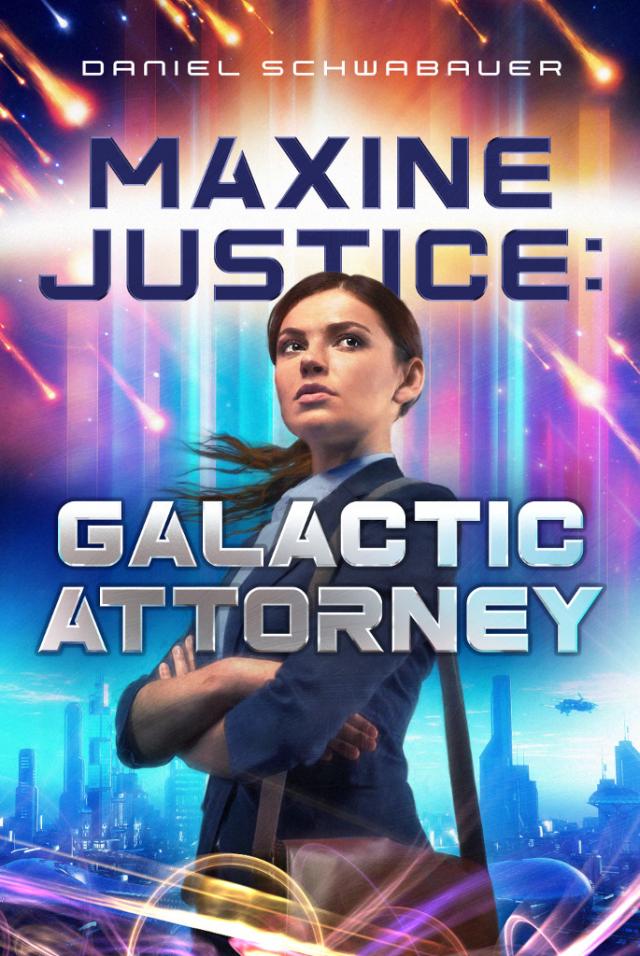


Acclaim for
MAXINE JUSTICE:
GALACTIC ATTORNEY
“A shot of suspense and a dash of pulp crime bitters—okay, maybe two shots—Maxine Justice: Galactic Attorney is a clever cocktail of courtroom procedural and science fiction. With snappy prose and fantastic characters, Schwabauer has created an unputdownable, utterly addictive tale that is pure fun to read.”
—Tosca Lee, New York Times bestselling author
“Daniel Schwabauer’s Maxine Justice brings a blend of the intriguing sci-fi of Kerry Nietz with the legal intrigue of John Grisham. This is one of those gripping page-turners that will keep you reading into the wee hours of the morning. I thoroughly enjoyed every minute!”
—Jill Williamson, author of the Blood of Kings trilogy and Thirst
“Maxine Justice is an incredibly fun read! It’s delightfully witty and surprisingly heartwarming. Schwabauer blends the right amounts of suspense, intrigue, and humor into a fast-paced read.”
—S.D. Grimm, author of the Children of the Blood Moon series and A Dragon by Any Other Name
“An intelligent, fallible, and courageous young lawyer stands up for herself and all of humanity in this entertaining novel from Daniel Schwabauer. Between the tight intergalactic courtroom drama and the discovery of her talent as an attorney, Maxine Justice is a formidable, and very human, character. Who better to defend Earth when the chips are down?”
—Kevin Ikenberry, author of Peacemaker and The Protocol War
Books by Daniel Schwabauer
The Legends of Tira-Nor series
Runt the Brave
Runt the Hunted
The Curse of the Seer
Operation Grendel
Maxine Justice: Galactic Attorney
Maxine Justice: Galactic Attorney
Copyright © 2022 by Daniel Schwabauer
Published by Enclave Publishing, an imprint of Oasis Family Media
Phoenix, Arizona, USA.
www.enclavepublishing.com
All rights reserved. No part of this publication may be reproduced, digitally stored, or transmitted in any form without written permission from Third Day Books, LLC.
This is a work of fiction. Names, characters, places, and incidents are products of the author’s imagination or are used fictitiously. Any similarity to actual people, organizations, and/or events is purely coincidental.
ISBN: 978-1-62184-222-4 (hardback)
ISBN: 978-1-62184-224-8 (printed softcover)
ISBN: 978-1-62184-223-1 (ebook)
Cover design by Kirk DouPonce, www.Fiction-Artist.com
Typesetting by Jamie Foley, www.JamieFoley.com
Printed in the United States of America.
To Mark and Teckla Wilson
The real Counselor Singhs
TABLE OF CONTENTS
Cover
Acclaim for Maxine Justice: Galactic Attorney
Half-Title
Books by Daniel Schwabauer
Title Page
Copyright Page
Dedication
1. Maxine Justice LLC
2. Lower Court
3. Counselor Singh
4. Premier Representation
5. Boilerplate
6. Lawfare
7. Trials
8. Shadow World
9. The Under-Undersecretary
10. The Big Leagues
11. Rake-Off
12. The No-Go Zhou Show
13. Greed
14. Oliver Wendell
15. Enforcement Clause
16. Attorney-at-Large
17. Higher Court
18. Breach of Contract
19. Payment
20. Criminal Defense
Acknowledgments
About the Author
Operation Grendel
Maybe if I hadn’t been stone broke, two months behind on my office rent and three on my apartment, in debt to Kenjiro, my law clerk, for six weeks’ back pay, and completely out of cat food for Oliver Wendell, I wouldn’t have taken that night-court shift down at the Coliseum, and my name wouldn’t be the subject of worldwide scorn.
But ever since the law firm of Hinkle, Remmers & Schmidt kicked me to the curb—after Brandon Schmidt Jr. lost a slam-dunk case and blamed me for it—well, things hadn’t been going so smoothly for Maxine Justice LLC.
People think attorneys make a lot of money, but the truth is, most of us in the personal-injury racket only made real bank three or four times a year. The rest of the time, we spent baiting lines. Eventually you either burned out and went to work doing research for a government firm, or you built a steady flow of victims and started pumping the insurance industry. Both those options were out of reach when you were still twenty-seven and your Justice Department dossier stated—in capital letters—that you’d failed the bar exam three times. No one ever asked about the circumstances.
No, you just had to keep throwing chum in the water at the children’s hospital or homeless shelter, counting down the digits in your bank account until financial misery forced you to take a shift at the lower court under the downtown stadium.
(Sidebar: It was also theoretically possible to land a stint in Air Shield’s Experimental Medicines Lab on K Street. At least there, you might contract something debilitating and negotiate for a permanent disability. But you couldn’t count on luck—a fact I’d learned the hard way when I was eleven—so I’d grudgingly filed for night duty near the end of the summer.)
When my rotation option came through, I tried the last thing I could think of to weasel out of it, which was asking Mom for money. I mean, she donated half of her retirement checks to network charities anyway. Maybe she would warm up a little and give me a loan. All it would cost was the tiny slice of dignity I kept in reserve for emergencies.
“Hey, Mom,” I said when she picked up. “It’s Maxine.”
“Who?”
“Very funny,” I said. She had to know who was calling; I was using her old phone, Digie. In the background, I could hear the match buzzer from her favorite game show, Winner, Winner, Chicken Dinner!
“Eufie?” she said after a pause. “You forget your real name all of a sudden?”
“No, Mom, but I’m Maxine now. I told you last time we talked. I had it changed at the courthouse so—”
“What, the name I gave you wasn’t good enough? Hold on. Can you believe these people? Three nights in a row she wins, and does she take the money and run? No. She says, ‘Let it ride. Let it ride,’ she says.” Another pause. “So, what did you have to go and change your name for, huh?”
I sighed. We’d been over this. “No one wants to hire a lawyer named Eufemia Kolpak, Mom.”
“Well maybe nobody wants to talk to a daughter named Maxine Justice either. G’bye, Eufie!”
Click.
That’s a verbatim transcript. I can still hear her sneering huff as she hung up.
On the plus side, she hadn’t asked me when I was going to repay the last loan she’d given me: one hundred qoppas for food during my final semester at school—at 7 percent interest. I now owed her almost Ϟ140, a fact she reinforced with monthly statements sent via paper envelopes and the United Republic Postal Service.
So I had no fungible assets, save a tired student credit chit that was nearly maxed out and whatever loose change I could find behind my sofa cushions.
Of course I still had my main assets—the things that had seen me through law school and several other traumatic adventures—namely, an unconscious and wholly inaccurate aura of personal humility, my natural ability to charm regular folks even when they knew lawyers to be scum, a battered leather messenger bag that I planned to carry to my grave, and something my former employer had called “ratlike instincts.”
If the latter doesn’t sound like a compliment, you’ve never hired a personal-injury attorney.
Oh, and I also had a collection of animal freeloaders that seemed to recognize in me a kindred spirit: the squirrel that made its nest on my back porch, a dozen or so mice, a pair of doves nesting under the eaves, and the aforementioned stray tomcat I’d dubbed Oliver Wendell Homey. Oliver Wendell loved his free speech, particularly at 3:00 a.m.
Eventually I forced myself to grab my battered messenger bag and hop tubes to the Coliseum. The bag was more practical than a purse and had become something of a trademark—a way to stand out from a sea of young lawyers toting black attachés. Sure, it was gouged and patched and stained with layers of who-knew-what. And yes, it did indeed make me look like I’d just returned from a trek through the Amazon, searching for gold ingots. But that was part of its charm. I liked to think it sent a message to my clients: some things are worth fixing.
Of course, I couldn’t prove that last point; I didn’t have any clients.
The registrar’s office was underground, just off the public-transport gate, which meant I had to walk past the welcome mural in the Justice Department’s foyer—a sunrise over the harbor, complete with the 8:00 a.m. skyboards.
It was bad enough the city of York had designated the harbor horizon as commercial space, but to brag about it? In the morning, you couldn’t even look east toward the Statue of Self-Determination without also seeing the toothy smiles of my former employers.
HINKLE, REMMERS & SCHMIDT
Over Ϟ1 Billion in Verdicts for Our Clients
You’ll Smile Too!
Now the ad was staring back at me from the Justice Department wall, a fact which made me want to bleach the inside of my eyelids and look for housing in a coal mine.
Inside the gateway, music thudded from the passably lifelike sun panels in the ceiling, punctuated by the occasional screaming of the crowd in the stands three stories above. I hadn’t bothered to see what was playing tonight—concert or sporting event—but now I knew.
I slipped through a maze of ever-diminishing hallways and nudged open the door to the court-bookkeeper’s office.
Mr. Fagan, the dwarfish codger who had scheduled many of my shifts back when I was an intern, still worked the kiosk behind the counter like some mummy slaving under an ancient curse. Just now, he was staring at a screen as Nadia Zhou, host of The No-Go Zhou Show, plied some unfortunate victim with invasive questions.
Fagan squinted over thick, smudgy glasses when he saw me. “Eufemia Kolpak, a.k.a. Maxine ‘Will She Make It?’ Justice. Congratulations on escaping the high-price roller coaster of negligence and embracing the moral crusades of the circus.”
“Nice to see you, too, Mr. Fagan.”
“Oh, I doubt that. But it will be nice to have a competent PD on the roster this evening.”
I smiled at the compliment. “Who’s on the circuit? Don’t tell me it’s Wentworth.”
Fagan shrugged.
“You’re kidding.”
“I have no sense of humor. Or so you once said.”
I groaned. “Wentworth hates me.”
“Technically not possible, though I admit his past behavior toward you has not been especially friendly.”
“Think he’s still on the take?”
“Careful,” Fagan said, swiveling the kiosk around for me to sign. “Someone might think you were serious about bribing an auto-judge when we all know that’s impossible.”
I could tell from the furrow of his brow that he was being sarcastic. “Especially without the chit-coin,” I said, looking down at the contract. I scanned to confirm it was the same boilerplate and stopped just short of pressing my thumb to the confirmation box. “Are you serious? Two hundred qoppas? They’ve actually reduced the per diem?”
Fagan shrugged again. “You should see what they pay me.”
I should have walked away out of principle. They’d paid Ϟ235 per night to registered attorneys when I’d worked here as an intern. Back then, my time had only paid in public-service hours toward my certification, but I was a duly sworn officer of the court now.
Still, two hundred qoppas would mean that tomorrow morning I could give Kenji part of what I owed him and also buy some groceries. Maybe Oliver Wendell would stop twitching his tail at me whenever I came home.
I sighed and pressed my thumb to the box just as the door behind me swished open.
“Counselor,” Fagan said, nodding over my shoulder at the new arrival before turning the screen around. His voice now carried a tone of professional courtesy I’d only ever heard directed at other people. “Ms. Justice, you’ll be in room A-14, assigned to Courtroom C, the Honorable Judge Wentworth presiding. I show seven current cases on the docket, but you should expect more as the evening progresses. Twenty credits for the cafeteria have been added to your account, which you can access from your terminal. The coffee in the lounge is, of course, free.”
I’d heard this speech many times, but never given to me. Interns didn’t get cafeteria credits, and somehow that little perk warmed my heart, even though the food from those kiosks was barely edible.
“Thank you, Mr. Fagan,” I said, dialing in my own professional voice. “I’ll—”
“Ah, Ms. Justice,” the newcomer said in tones that sent fingernails across the chalkboard of my soul. “So nice to see you again.”
Even before I turned, I had the stomach-churning realization that the multiverse did indeed hate me, and everything bad that had happened in my life to this point had been just a warm-up exercise.
I hadn’t seen Counselor Singh in four years and hadn’t wanted to. He wore the same black, long-sleeved shirt and clerical collar I’d last seen him in, the same pleated khakis and leather loafers, the same neatly trimmed salt-and-pepper beard. Each of the hundred or so times I’d seen him at the lower court, he’d always worn the same thing.
TheraPod counseling units weren’t human, though you couldn’t tell that by looking at them—or even by talking to them. Which was why their designers assigned them the dull, unchanging uniform of their position. Anyone could tell from a cursory glance that Singh was some flavor of clergy—not a priest, but a “minister.”
In short, Counselor Singh was a pastoroid. One of the older models, and one with an apparent glitch: he had the annoying habit of quoting scripture in mixed company. Worse, he had a sense of humor—loosely defined.
With any luck, Wentworth would assign him early to some poor schmuck who needed help overcoming the urge to bash thy neighbor.
But since when, I wondered, had luck wandered beneath the Coliseum to the hallways of Courtroom C? Luck, as far as I could tell from this distance, was a certifiable snob.
“Counselor Singh,” I said without conviction. “How nice to see you.”
He smiled warmly, as if he’d been looking forward to this reunion for years. Possibly he had. “A pastoroid, a rabbot, and an e-mam walked into a bar.”
Oh, no.
Behind me, Fagan made a snorting noise and turned away. Coward!
“Did they?” I said.
“The bartender looked up and asked, ‘Is this some kind of joke?’” Singh smiled, one eyebrow arcing into a question mark.
“God only knows,” I said.
“Ah,” Singh replied. “Excellent. Excellent. I have missed you, Max.”
“I’ll be in my room,” I said, turning toward the hallway. Sure, it was rude, but did I actually owe a TheraPod like Singh any formal politeness? I was willing to bet the Bible was silent on the subject of moral etiquette with androids.
“Ms. Justice,” Singh called, his tone abruptly serious.
Habit stopped me. In spite of my legal training, I found it difficult to be overtly rude in the face of kindness. Another flaw to overcome. At the doorway I looked back.
“Congratulations on opening your own firm. I’m sure that took a great deal of courage. Remember what Solomon said: ‘All hard work brings a profit.’”
“Uh, thanks,” I said. “Appreciate that, Counselor.”
“Also,” he said. “I heard about the way you were treated by tonight’s prosecutor. If you need to talk, I will be here.”
Tonight’s prosecutor? What—
But as I turned to the hallway, the answer to my unformed question resolved itself in the silk suit, tanned skin, and brilliant teeth of Brandon Schmidt Jr., now sauntering toward me like a big-game hunter gloating over a fresh kill.
“Eufemia,” he said, smiling hugely. “You should have told me you’d be here. I’d have brought your things.”
“It’s Maxine,” I said. “Maxine Justice. And you can send my things to my office. I’ll have Kenjiro forward the address.”
Brandon touched my shoulder, a can’t-we-be-pals gesture that made my jaw clench and my skin crawl. “Sure thing. I’ll send one of our couriers.”
I shrugged away the offending paw. “Don’t forget my toothbrush.”
“What made you come back here, Euf—I mean, Max? I thought you hated this place.”
As if he didn’t know I was desperate for cash. Brandon was the son of founding-partner Brandon Schmidt Sr., and Junior’s romantic advances had been directly responsible for getting me fired without so much as two weeks’ severance.
“Someone has to help the little guy avoid getting shafted by a silk suit,” I said.
He laughed. “Indeed. Well, good luck, and no hard feelings, whatever happens.”
No hard feelings? I almost couldn’t believe his nerve.
But the truth was I did believe it. Because whatever else he was, Brandon represented the sort of storybook life I hadn’t realized I’d wanted. He was handsome and wealthy, and his family traced its roots to generational titles and land and global corporations.
My history was written in collection letters.
His charm, when I’d first started working for his dad’s law firm, had seemed sincere enough.
That I hadn’t seen through it sooner still amazed me. More than one person had tried to warn me. But I just didn’t want to admit that I could be the fifth young hire sacrificed to Brandon’s appetites.