

The angels jig, p.1
The Angel's Jig, page 1


Facing the dwindling years of his life, the old man waits for his turn on the auction block, hoping to be sold to a family as decent as the one he is leaving. It is not the first time he has been here, and it may not be the last.
Mute in life but loquacious on the page, he tells the colourful story of his rootless past. Abandoned by his family and first auctioned off at the age of seven — “Ladies and gentlemen, this boy may not be a rare gem, but he is certainly worth a look” — he moves from one farm to another, taking comfort from the people around him.
Daniel Poliquin’s work of piercing wit and insight revisits an all-but-forgotten era, when orphaned children and the elderly poor were auctioned into a form of indentured servitude. Narrated through the eyes and ears of an unforgettable protagonist, The Angel’s Jig — a finalist for the Trillium Award in its original French edition — is a joyous meditation on identity and the unpredictable voyage of existence.
CONTENTS
Cover
Synopsis
Title Page
Contents
Copyright
Dedication
Preface
Part One
Part Two
Part Three
Part Four
Part Five
Part Six
Part Seven
Acknowledgements
Author Bio
English translation copyright © 2016 by Wayne Grady.
Original title: Le Vol de l’ange
Copyright © 2014 by Les Éditions du Boréal.
All rights reserved. No part of this work may be reproduced or used in any form or by any means, electronic or mechanical, including photocopying, recording, or any retrieval system, without the prior written permission of the publisher or a licence from the Canadian Copyright Licensing Agency (Access Copyright). To contact Access Copyright, visit www.accesscopyright.ca or call 1-800-893-5777.
Cover design by Julie Scriver.
Page design by Chris Tompkins and Julie Scriver.
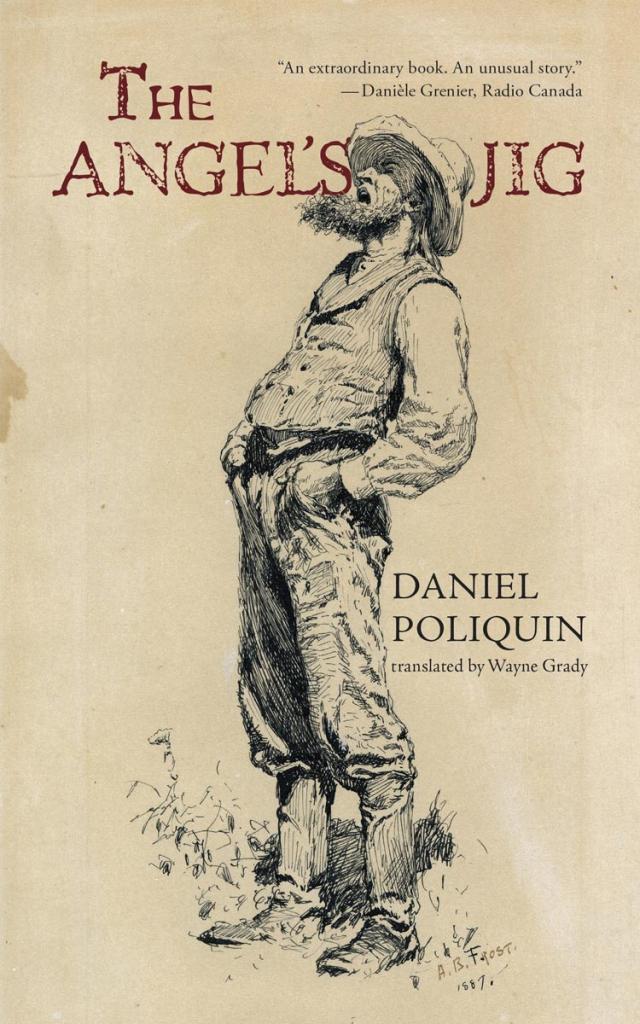
Cover image: Old Farmer, 1887, by A.B. Frost (1851-1928), pen and ink on paper. 12 x 7 in. Collection of the Norman Rockwell Museum (NRM.2006.15).
eBook by Brightwing Books
Library and Archives Canada Cataloguing in Publication
Poliquin, Daniel
[Vol de l’ange. English]
The angel’s jig / Daniel Poliquin ; Wayne Grady, translator.
Translation of: Le vol de l’ange.
Issued in print and electronic formats.
ISBN 978-0-86492-867-2 (paperback). -- ISBN 978-0-86492-741-5 (epub). --
ISBN 978-0-86492-838-2 (mobi)
I. Grady, Wayne, translator II. Title. III. Title: Vol de l’ange. English.
PS8581.O285V6413 2016 C843’.54 C2015-906820-7
C2015-906821-5
We acknowledge the generous support of the Government of Canada, the Canada Council for the Arts, and the Government of New Brunswick.
Nous reconnaissons l’appui généreux du gouvernement du Canada, du Conseil des arts du Canada, et du gouvernement du Nouveau-Brunswick.
Goose Lane Editions
500 Beaverbrook Court, Suite 330
Fredericton, New Brunswick
CANADA E3B 5X4
www.gooselane.com
Also in English by Daniel Poliquin
Fiction
A Secret Between Us
In the Name of the Father
The Straw Man
Black Squirrel
Visions of Jude
Obomsawin of Sioux Junction
Non-fiction
René Lévesque
In tribute to CCH, AC, SL, and especially, especially, ML, who will recognize themselves herein.
And of course to HM, MO, HC, and ES, who held my hand on so many occasions.
PREFACE
In Canada, which is a cold country, the name “angel’s jig” is given to that moment when someone walking or skating on a stretch of ice suddenly loses their footing and begins to beat the air with their arms in order to recover their balance. It’s an involuntary dance that invites either admiration, if one manages to remain on one’s feet, or merciless laughter, if one falls on one’s face. I’m told that this expression is not very widely used, and for good reason: I’m the one who made it up. Just as I made up the rest of the novel that follows.
What I didn’t invent, however, is the practice of auctioning off children and the elderly, a practice that was common in New Brunswick from 1875 to about 1925. It essentially involved reverse auctions conducted by the parish’s Overseer of the Poor or by a bailiff or some other officer of the court. Although at first glance it seems an inhumane tradition, it may not have been without its benefits: those in reduced circumstance — orphans and the aged — were kept out of orphanages and poorhouses, institutions that at the time had little to recommend them, and found themselves with a roof over their heads and gainful employment; farmers, for their part, benefited from access to cheap labour. These auctions were entirely local initiatives; no mention is made of them in the annals of the law or jurisprudence. I know, because I’ve checked. Mentioning these practices in the Maritime provinces today draws nothing but blank stares of disbelief, which is all the more reason for talking about them.
Naturally, the characters who populate this book did not exist before I wrote about them. But they do now.
PART ONE
They pretend there’s nothing going on, but I know something’s up. They don’t know that I know, but that’s neither here nor there. Whatever it is, I’ll be shipping out. Their skulduggery doesn’t bother me; they’re the ones who are stumbling around in the dark.
And pretty soon, too, I’m guessing. Most likely Saturday or Sunday. Next week at the very latest.
They don’t know they’re acting strange, but they are. The other day, for instance, the woman smiled at me, which I took to be a bad sign. The only other time she’s done that was at New Year’s, when I bought oranges for the whole family. The other day was when I soothed a toothache that had been making her life a misery for weeks. All I did was apply a compress of salt and cloves, a remedy so ancient that these poor souls must be the only ones who didn’t know it. When the pain eased, she couldn’t hide her pleasure. She even managed to squeeze out a syllable or two of thanks. She needn’t have bothered for my sake; she smiles so rarely that the slightest twist of happiness on her face only makes her sour expression that much worse. There’s so little room for joy in that woman that even the lullabies she mutters to the child at her breast sound like funeral dirges.
Another bad sign: last Sunday, after supper, the husband offered me his tobacco pouch. The last time he did that was also at New Year’s. I refused it with a shake of my head, meaning no thanks, I still have some of my own under the bed, in a small tin box. Then he did it again yesterday, after I helped him with the chores. Maybe he thinks that these small gestures will make me forgive him for what he intends to do. No need to get so worked up about it. I’ve got no right to judge him: I know how hard up they are, I don’t begrudge either of them, the husband or the wife. I’d probably do the same thing if I were in their shoes, take me down to Cap-Pelé and auction me off to someone who’s better able to keep me than they are.
The children know something’s up too, but they don’t know what it is. They must’ve noticed that the woman’s cooking hasn’t been up to scratch lately, and there’s never anything for dessert, and the man doesn’t sing in the mornings anymore when he crawls out of bed. The little ones go around looking sad all the time, which breaks my heart; they’re too young to understand why the place is suddenly so gloomy, and their parents have no way of explaining it to them, and so there’s nothing left for them but a big emptiness that smells like incense at a Mass for the dead. I miss their innocent joy, their happy games, their huge appetites, their good-natured bickering. They’re all I’ve got for entertainment around here, and their silence is like they’re waiting for the axe to fall.
One final, unmistakable sign: the woman and the man are speaking normally to me, instead of yelling. I’ve been living with them for four years, and they’re only now beginning to understand that I can hear them perfectly well, even though I’ve not uttered a word in my life. I’m neither deaf nor dumb; I just don’t talk, that’s all. It’s a promise I made to myself when my mother was still a young woman, before I was even conceived, when my existence was nothing more than spirit. A bit like the vow of silence that monks and nuns take in their cloisters. But for these people, language is the only country they know, the only thing they own, and to them I’m a kind of voluntary exile, which is all right by me.
The problem is, to the people around here, I’m what they call a nutcase: they think they have to talk to me at the top of their lungs and use fancy hand gestures that are insulting to me and make them look like idiots. No wonder my jaw drops if anyone speaks to me in a normal tone of voice, the way they’d speak to someone who has a brain in their head. Take the doctor’s housekeeper in Barachois, for example, whose acquaintance I have recently had the honour of making. When we were introduced, she spoke to me so naturally you’d think she was talking to an ordinary man, and right away I wanted to hop into bed with her.
Never mind the parents — the children accepted me for what I was from the first day I got here. So did the housekeeper, and now it’s her face I call up when I need something to help me get to sleep at night. (When I was a boy, I invented imaginary friends in order to feel less alone. When I became a man, I loved imaginary women. Real ones, too. Well, one, anyway. Maybe two.) Now that they’re up against it, the man and his wife finally seem to believe I possess a degree of intelligence. They still don’t know that I speak in my head — that I can speak perfectly well, in fact better than they do. I have an extensive vocabulary that includes several complicated words that are hard to pronounce. I like forming long, winding sentences in my head that you won’t find anywhere else except in books nobody reads anymore. I’ve also learned other languages; you should hear me talking to trees and flowers, and to woodland creatures, to fish and birds, wild and domestic, to stones, and all without the slightest trace of an accent. I understand the stories the wind, rain, and snow bring me. As a general rule, however, I avoid conversations with hurricanes and forest fires; I make myself scarce when I see them coming. Finally, I understand the phantom language still spoken by members of my clan. They may be losing their mother tongue and using some other kind of language, but their speech patterns and colourful expressions all come from that long-vanished world. I’ve inherited this secret knowledge from my mother.
Once, and only once, someone nearly saw through me. She was passing herself off as a deaf-mute, but I’d been playing that game long enough to recognize a fellow performer when I saw one. She was a former circus rider who had fallen on hard times and ended up washing dishes in a tavern in the small port town of Richibucto. She’d also tried her hand at prostitution, but she wasn’t much good at it. She was too small and thin; sailors didn’t like her short hair, her ageless face, her body smooth as a polished ship’s rail. Without her clothes on, she looked like an undernourished twelve-year-old — no breasts, no bum, and her tiny, nearly hairless mound. There was always a faint smell of horse manure about her, too, a professional hazard, I guess; she could never pass a horse in the street without hugging it, kissing it, and whispering in its ear. The few johns who went with her when there was no one else around would change their minds as soon as they saw her in her room’s feeble light, and more often than not would skip out without laying a finger on her, as if they thought they’d be breaking some kind of taboo. They didn’t like her not speaking, either. She used a sign language she’d picked up in some foreign country, and no one around here could understand it.
When I first ran into her, I thought she was an aging cabin boy who was waiting for his next sea berth, and I agreed to share his room as a favour to the landlady. But we figured each other out pretty quick. It was hunting season and I was away a lot, but the first of the month I got back she offered to pay me her share of the rent in kind. (I’m skipping over a few things here, because actually it took us a long time to work all this out, for her to explain it and for me to get it.) I refused outright. I signed to her that I only went with women, and besides, I’d never paid for sex in my life. She simply got undressed and clung to me with a tenderness that was not of this world. I made up for my mistake by doing everything she asked me to do. I couldn’t refuse her a thing after that, and I’ll be damned if I even tried. When I finally let myself go inside her because I couldn’t hold back anymore, she’d already come four times, most of them straddling me like a horse, and I found her whinnying went well with the horsey smell. Lying in her strong, circus-performer’s arms, I became a different man; when I slipped out of her, exhausted, covered with her sweat and her more intimate juices, I knew at last that life was worth the candle. When she slept, she became plain again, her brow furrowed and her mouth hanging open. I’m no prize myself when I sleep, and so in order not to see her or let myself be seen by her, I slept on the floor, wrapped in a small damp rug.
She also knew the secrets of my mother’s phantom language. She’s the only one who tried to understand my silence, and she almost managed it. But we should never have got drunk together, which is what we did at night, after our tussles in bed. As soon as she got a bit of drink in her, she’d start in on me, asking me who I was, where I came from, what I was doing there. She kept at it, and when I put her off too much, she would sign words at me that made me mad, and which I couldn’t get out of my head: “Your silence is a lie, you’re no good for anything but a good fuck, why don’t you just kill yourself and rid the earth of the useless piece of crud that you are” — all that and a lot more that I won’t repeat because there might be ladies present. But despite all that, I couldn’t bring myself to stay angry with her. In fact, I was beginning to fall in love with her.
It was her fault I was arrested, although I know she didn’t do it on purpose. She was almost caught trying to steal a briar pipe that she wanted to give me as a present, to make up for her drunken harangues. The Mounties wanted to know if she had more stolen goods in her room, and so they followed her home. As soon as they set foot in the door, the senior officer looked at me and yelled: “It’s him!” (He recognized me because he’d arrested me once before, a long time ago, for poaching wild turkeys. He’d had to let me go for lack of evidence, which only showed that he was an honest man, for a cop.) The other Mountie, a constable, was less considerate; it was the woman he was interested in. He rummaged through her meagre possessions, demanding to know where she had stolen this or that, throwing her things on the floor and crushing them under his boot heel for the sheer pleasure of seeing her wince. This proved too much for the officer who had arrested me earlier: he told the constable to behave like a gentleman.
They brought me in, uncuffed at least, and left her in the room, although the nastier of the two promised her he’d be back. I never saw her again, but I’ve often thought of her pale, shame-faced expression, the look of a little girl caught doing something wrong. She stared fixedly at the broken jewellery on the floor, her gaze looking inward as at a long-forgotten memory.
I miss her sometimes, but not so much since I met the housekeeper.
That’s another thing: the woman and her husband have stopped talking about me as though I wasn’t right there in the room, as people do with old geezers who have lost their minds. Now when they talk about me, they just lower their voices and move away a bit so they can speak more freely, and all I hear are murmurs, which would drive me crazy if I didn’t already know what they were saying. They feel guilty about what they have to do, even if they haven’t done it yet.
I’d like to tell them in a quiet way that it’s not a crime, what they’re planning, so stop twisting yourselves up in knots over it. All they’re doing is taking me down to the bailiff’s office to have me placed in a different home, and that’s fine with me, I know the drill; after all, it’s how I got here in the first place. All I want to know is when. I need to be prepared, in case the auction doesn’t go well. Because if my services don’t find a taker, my next address could be the old folks’ home, where people generally croak before you can say “senile dementia.” The food is abysmal, medical attention practically nil, and most of the inmates decide to kill themselves before they rot to death.
There’s even worse that could happen. If nobody wants me, the Overseer of the Poor has the authority to transfer me to another county, where conditions could be even worse. In the southwest, at Memramcook, for example, the poor who are sold at auction usually go to large farmers, more like plantation owners, who pay an annual lump sum to the parish — forty or fifty dollars a year — in exchange for which they can make you work as hard as they like. You get your room and board, but that’s it. They take children as well as old people. At the end of the year, the planters pay the parish the same again if they want to keep you on, but if they don’t want you anymore, because you’re too sick or old to work, they send you back to the auction block. These planters don’t care about their workers; they feed you barely enough to keep you alive, and make you sleep in barns all year long, on beds crawling with lice and ticks and what have you. I once met a gentleman on one of these farms who was a hundred and three years old. They had him picking berries and mushrooms when they were in season, and pumping the bellows in the blacksmith’s shop in the winter. He didn’t dare complain, but you’d have had to be blind not to see that he was sorry to have lived to be so old.






