The hellfire club, p.4
The Hellfire Club, page 4
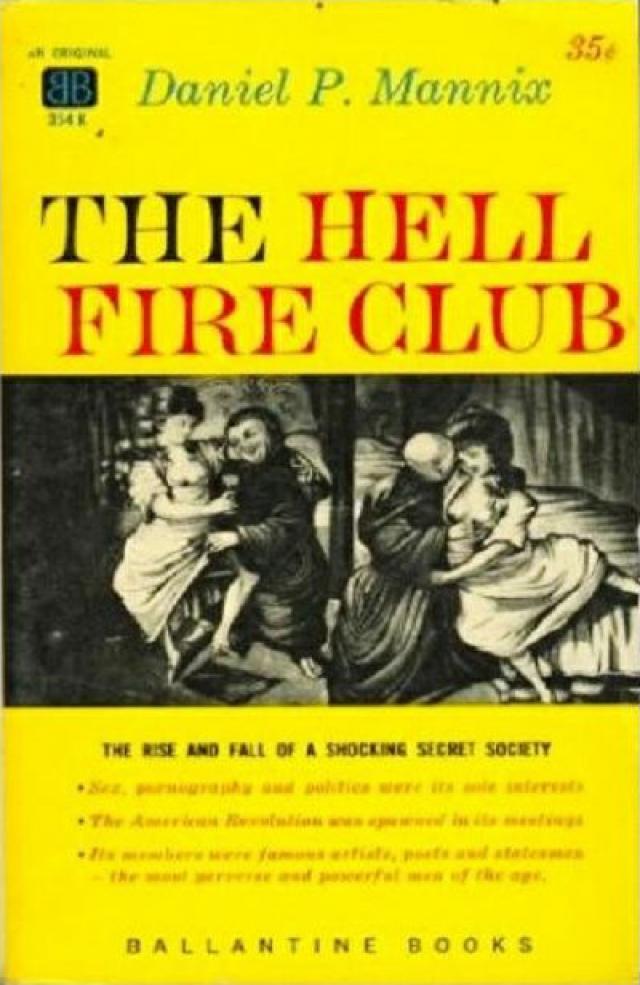


After the Abbot of the Day had made his choice, the other members paired off with the girls. The girls kept on their masks no matter what else they took off, “so that no misunderstanding may arise from an unexpected meeting with one’s legal husband or professed admirer.” The couples could retire to one of the cells in the Withdrawing Room, wander out into the garden or go to Trophonius’ Cave. Apparently most of the couples preferred to remain in the Roman Room and build uptheir passions by voyeurism (sexual gratification from watching the actions of others). Thenmonks and nuns undressed each other and after considerable by-play, which often included the recital of magical hymns and incantations, retired to the couches. The communal aspect of the business added to its flavor.
Exhibitionism, as typified by the voyeurism, was for some reason or other a deeply ingrained characteristic of the period. It was the controlling factor in Sir Francis’ life and that of many other men. Quite probably it was the result of the feeling of insecurity which overhung the time—the same feeling that today causes a certain type of young man to go in for sideburns, leather jackets, elaborate mannerisms, and endless boastings of his amatory exploits. The Hell-Fire monks with their robes, Black Mass ceremonies, and sexual exhibitionism carried this business to extremes as they did everything else. They couldn’t even have sexual relations without an audience. Later, this craving for exhibitionism was to result in the worst riots in the history of London, provoked by a futile young lord in desperate need of recognition.
In John Cleland’s famous pornographic workFanny Hill, written in 1749, there are elaborate descriptions of this voyeurism. In the brothels of the period, couches were arranged around the walls for these community exhibitions. Couple after couple would retire to the couches in full view of the others and, after they had finished, watch the others take their turns. The Hell-Fire Club’s Roman Room was designedfor this purpose. It is interesting that inFanny Hill, the men who insisted on these exhibitions are described as young lords. Ordinary clients preferred privacy. Apparently the aristocracy needed the inspiration of each other’s company before they could perform the sexual act.
Most of the “nuns” were recruited from the fashionable bagnios of London. Many of these brothels were as well known as the famous coffee houses such as Almak’s, White’s, and Boodle’s. Some of the more elegant bagnios were Moll King’s, Constance Phillips‘, Lucy Cooper’s (who was called “lewder than all the whores of Charles II’s reign”), and Elizabeth Roach’s. Possibly the most fashionable was Charlotte Hayes’ establishment. We know that Charlotte provided some of the Medmenham nuns, for there is a record in her account book: “June 18, 1759. Twelve vestals for the Abbey. Something discreet and Cyprian for the friars.”
Sandwich said of Mrs. Hayes, “She keeps the Stock Exchange supplied with real, immaculate maidenheads.” Each morning “she took her rounds to see what youth and beauty the country had sent to London. When she found a fresh and pretty rural lass she tricked her up with patch and p aint… a creature whom she always called a milliner or a parson’s daughter.”
Some of the extracts from Mrs. Hayes’ account book are interesting:
“Jan. 8. A maid for Alderman X. Nell Blossom, aboutnineteen, has not been in company these four days and was prepared for a state of vestalship last night.
“Feb. 2. Colonel Y. Wants a modest woman. Mrs. Mitchell’scook-maid being just come from the country and a new face? Or the Countess La Fleur from Seven Dials? If so, her flash-man, La Fleur, must dress her to the best advantage.
“Feb. 17. Dr. Z. After church is over.”
From Hogarth’s series of etchings called “The Harlot’s Progress” and from other sources, we can reconstruct not only the life of these girls but how they were secured. The madams made a business of visiting the inns where young girls who had come to the big city “to make their fortunes” were likely to stay. The madam was an expert at getting information out of a young girl without seeming to ask questions. Usually she offered to buy the girl a glass of wine or some other refreshment. The approach of “Mother Stanhope” ran like this:
“I like to be jolly myself and see others so. I’m getting on now… ain’t what I was once. But as I says I like to be jolly and I always is. An old fiddle, you know, makes the best music.”
Sounds like Ma Perkins. After this homey approach, Mother Stanhope would find out if the girl had any friends in London or if her relations in the country were in a position to make trouble. Mother Stanhope always tried to get the name of some distant relation of the girl’s. She wouldthen exclaim in astonishment, “Don’t tell me that Martha Brown is your aunt! Well, well, I know Martha well… although I haven’t seen her for a year or two. So you’re Martha’s niece! Now you must stay at my house while you’re in London. I won’t charge you a penny and I’ll write to Martha that you’re with me.”
Once in the house, the girl was then offered a job at an excellent salary, generally as a milliner. However, it was necessary for her to sign a contract as an apprentice. As soon as the contract was signed, the girl was then drugged and raped by the establishment’s “bully” or what we’d now call the “bouncer.” When she recovered, she was told that she was now ruined and could hope for nothing but a career in the bagnio. The contract was produced and in the fine print the girl discovered that she had sworn to put herself completely in the hands of her “protector.” Actually, the contract had no legal basis but the terrified country girl had no way of knowing that.
The first house to which the girl was taken was generally-“a breaking-in house” or, as Fanny Hill calls it, “a place where the girl was broken to the mounting block.” Afterwards she was sent to the regular house. However, in the really de luxe establishments the girl was set upin her own house or at least in an apartment, and the illusion was given that she was a lady of leisure who occasionally received gentlemen visitors. She was given fashionable clothes, a petmonkey, and a little Negro servant boy dressed in Oriental costume, as these props were considered absolutely necessary for a lady of fashion. However, whenever she went out she was always followed by an older woman (generally a retired prostitute) to make sure that the girl didn’t sell any of her finery and make enough money to escape.
It may be wondered why the girl didn’t cry for helpas soon as she got out of the house. Some of the girls who proved difficult were kept as virtual prisoners, but most of them, having lost their virginity and having signed the bogus contract, felt that there was no other course open to them but a life of prostitution. Also, for the first time in her life the girl was well-fed, wore pretty clothes, and was able to meet men of some refinement. The only other work open to most of them was as a servant in some home. Being a servant wasn’t a very attractive prospect. For example, here’s what happened to a seventeen-year-old girl named Mary Clifford in 1767. Mary had offended her mistress, Elizabeth Brownrigg, and when a neighbor accidentally found the girl tied in an outhouse she looked like this:
“Her head was swelled to almost double the natural size, and her neck so much that she could neither speak nor swallow. Her mouth stood open and the doctor who examined her deposed that she was all one wound from her head to her toes, that her shift stuck to her body, that she was in a fever and the wounds had begun to mortify from neglect.”
Most girls were willing to settle for a life of shame.
As long as the girl was being kept by a series of single men, she was comparatively well off, although naturally most of the money she made went to the madam. However, when her charms began to fade, she was put in a house with a number of other girls. Here she was forced to entertain everyone from highwaymen to nobles. Part of her duties were to rob the guests. Hogarth in a painting depicts such a scene. A young rake, two-thirds drunk, sits in a chair while one of the girls steals his watch and passes it over to the madam. Beside the rake are a watchman’s staff and lantern, souvenirs of an attack on the watch; much as modern young Englishmen on a drunk feel it necessary to show their valor by coming back with a policeman’s helmet. In another part of the room, two girls are having a fight. One spits a mouthful of wine into the other’s face and her furious adversary is going for her with a knife. In a corner are a blind harper, a ballad singer who probably specialized in obscene songs, and a trumpeter, all hired for the party. The table is covered with broken wine glasses and overturned bottles. The mirrors are smashed and a roast chicken with a fork stuck in it lies on the floor. This is unquestionably a very accurate picture of the windup of an 18th Century party in a brothel.
When they weren’t drunk, the girls seem to have got on together like one big happy family. We read about themsharing their clothes together and having fights when one girl borrowed another’s stockings without asking permission. Although the “house” girls never did any soliciting on the streets, they frequently attended masquerades, where they were often picked up by gentlemen who thought they were respectable women out for a good time. After a great deal of protesting, the girls would allow themselves to be seduced and then, amid tears and hysterics, demand a large sum for their ruined honor.
The end for these girls was usually the workhouse. Hogarth shows such a scene. The girls are pounding hemp with mallets. An overseer with a cane moves among them. One girl is hanging by her hands in the pillory, over which is written: “Better to work than to stand thus.” The girl standing in the center of the picture is Mary Moffat, who was arrested for debt and dragged off to prison still wearing her brocaded evening gown covered with rich lace and silver thread. Hogarth sketched her from life.
A handful of these girls were able to rise above their environment, and a few even made brilliant marriages. Nancy Parsons, after being the mistress of the Duke of Dorset and the Duke of Grafton, married the wealthy Lord Maynard. Nancy used to boast that she had once received one hundred single guineas in a day from one hundred different gentlemen. Fanny Murray, the twelve-year-old girl who was seduced by Jack Spencer, married Mr. David Ross, a wealthyand respectable gentleman. Fanny always boasted that she had been one of the nuns of Medmenham. But these were the rare exceptions, although they were always held up to the “does” (as the novice prostitutes were called) as an example of what an ambitious girl could do.
In addition to the regular prostitutes there were the amateurs or “dollymops,” as they were called. The dollymops were “respectable” girls who occasionally did a little soliciting on the side either to pick up pocket money or just for fun. It was to protect the dollymops that the Medmenham nuns were masked.
A dollymopwas generally started on her career by being seduced by some man who afterwards deserted her. A popular dollymopballad ran like this:
“The first I met a cornet was
In a regiment of dragoons,
I gave him what he didn’t like
And stole his silver spoons.”
The flower girls who sold flowers in the streets were often dollymops. So were milliners. Sometimes they worked out of “introducing houses.” In these houses, meetings between girls and men were arranged by a go-between, although nothing improper was ever allowed to take place on the premises.
A few dollymops were prominent society ladies. The most famous of these was Miss Chudleigh. She was the mistress of the Earl of Bath and the Duke of Hamilton. She turned upat the Venetian ambassador’s masquerade in the “character of Iphigenia.” Miss Chudleigh’s interpretation of this role was to wear nothing except a transparent, gossamer veil and a wreath of roses around her middle. She was later secretly married to the Earl of Bristol, but started living with the Duke of Kingston. Miss Chudleigh saw the chance of becoming a duchess, so she sneaked into the church where she had married the earl and tore the record of her marriage out of the register. She then married the Duke, who gave the Earl 50,000 pounds to keep quiet, but the Duke’s family did some investigating and found out the truth. Miss Chudleigh was tried by the House of Lords for bigamy and narrowly escaped being branded with a hot iron. She was forced to leave the country and retired to the continent. There she lived with Frederick II of Prussia, the Prince of Radzivil, and several of the Russian and French nobility. In France, she bought a palace and settled down with her coachman. She died at the age of sixty-eight.
There were many stories told about her. Knowing her insatiable passion for sex, Sir Robert Keith remarked that he’d gladly marry the lady if a grenadier guardsman would join him in the nuptials. It was said that she’d given birth to illegitimate twins, and Miss Chudleigh asked Lord Chesterfieldif he believed the scandal. The lord replied politely, “I make a point of never believing more than half of what I hear.” When the Princess Augusta (the wife of Frederick, Prince of Wales, who was living with Lord Bute) reproached Miss Chudleigh for her private life, the young lady retorted in French, “Your royal highness knows that every woman must have her goal.” The French for goal isbut, pronounced “bute.” Her reputation for doing everything double was so great that when a two-headed calf was born in Essex, Horace Walpole insisted that Miss Chudleigh must have given birth to the animal.
Compared with Miss Chudleigh, the poor girls who were forced into prostitution either by poverty or the machinations of the madams were quite respectable people.
The members spoke proudly of the “amoristic acrobatics”of some of the girls and described the various positions in great detail. From the descriptions, many of the prostitutes must have been expert contortionists and the monks pretty supple also. These various positions are illustrated in theKama Sutraand in John Cleland’sFanny Hill(Cleland was a famous rake who lived at this time and may have attended the club’s meetings). Some of them require three or four people working as a team to perform. Some of the positions also require apparatus such as the “musical balls.”
“night-caps,” and “blessers.”
One device which was provided for the ladies was theIdolum Tentiginis or “lustful toy.” This was a rooster hobby-horse with the beak in the form of a phallus, the bird’s neck being turned around so his beak lay along his back. This Idolum Tentiginis was for the nuns to ride to get uptheir passions. For the male members, there was a small dispensary where aphrodisiacs could be compounded.
The monks were very proud of their potency. One member-kept a score chalked up on the door of each monk’s record for the evening. The nuns were well taken care of. A doctor and a midwife were kept in constant attendance on the premises not only to mix the aphrodisiacs and revive the members who passed out, but also to care for any nun who became pregnant. The doctor was Benjamin Bates, an esteemed local practitioner and a Scholar of Aylesbury. The children born to the nuns were called “The Sons and Daughters of St. Francis” and as they grew upthey were given jobs around the abbey.
As might be expected, venereal diseases were common among the brotherhood. They used to address each other as Signor Gonorrhea and Monsieur La Croix de Venus ( syphilis). Several died either of the diseases or from complications resulting from the infections.
At some time during the evening, a banquet was held in the Roman Room. Sir Thomas Stapleton calls these banquets “exquisite and Gargantuan.” The table was spread with damask and glistened under the candelabra with thegleam of silver and fine cut glass. A special Hell-Fire punch was served in a silver bowl (the recipe for this brew has unfortunately not come down to us) and the bread was Holy Ghost Pye. The various dishes had colorful names: “Breasts of Venus” (two squabs served side by side with a single red cherry on topof each) and “Devil’s Loins” (roast beef cut in the shape of buttocks). An incredible amount of liquor was consumed. The wine books for the club have recently turned upin Wycombe and show that each of the monks generally consumed three or four bottles of wine at a sitting. Two of the brothers drank four bottles of port, two of claret, and one bottle of Lisbon during a meal. Men were rated by the amount of wine they could drink, and a rake was referred to as a “three-bottle man” or a “four-bottle man,” depending on his capacity.
The monks also drank special cocktails called “Strip Me Naked.”
“Lay Me Down Softly,” and so on. The recipes have been lost, except that, judging from some of the names (“Gin and Sin.”
“Gin and Fanny”), gin was apparently the main ingredient.
So far, only the members’ dissipations have been mentioned, but Sir Francis and many of the other members were intensely interested in other subjects besides liquor and women. Sir Francis founded the Dilettante Club which probably did more than any other groupof the time to forward an interest in classical art. The club subsidizedThe Antiquitiesof Athens, by Stuart and Revett, the first important work on the ruins of ancient Greece, and also sent out the archeologist who discovered the ruins of Herculaneum and later of Pompeü. Dashwood and other wealthy members subsidized artists (including Sir Joshua Reynolds and George Knapton) and several young sculptors and poets who never reached such prominence. It was the rule of the group that whenever a member married, he had to pay the club a percentage of his wife’s dowry. (No young gentleman of family ever considered marriage unless the lady brought him a substantial income.) This money was used to purchase rare antique vases, statuary, and old manuscripts, most of which were then presented to museums. Like all clubs of the time, the Dilettante was a pretty gay group. Walpole remarked that the “nominal qualification for a member was having been in Italy, but the real one was being drunk.” However, they accomplished a great deal for art and archeology. Many of the Hell-Fire groupalso belonged to the Dilettante.
Sir Francis organized another club which didn’t resound much to his credit, but should be mentioned as an illustration of the baronet’s love of make-believe. This club was called the Divan. To join, you had to have traveled in Turkey. The members dressed as Turks and held banquets to which ladies of easy virtue were invited. One of Dashwood’ssisters was a member and was painted in her harem costume. Dashwood was grand master, and there was also an Impwho dressed in red, as the baronet loved a hint of the diabolical in everything.