Exotic 28 29, p.1
Exotic Gothic 4: Postscripts 28/29, page 1
part #4 of Exotic Gothic Series


Contents
Preface: On Dark Gifting
AUSTRALASIA
Blooding The Bride
Pig Thing
The Lighthouse Keepers’ Club
AFRICA
The Look
Nikishi
The Fourth Horse
ASIA
The Fall
In The Village of Setang
Carving
LATIN AMERICA & THE CARIBBEAN
Water Lover
Escena de un Asesinato
The Old Man Beset By Demons
Atacama
EUROPE
Metro Winds
Mariners’ Round
Oschaert
Helena
Rusalka
NORTH AMERICA
Candy
Down in the Valley
Wanishin
Grottor
Such A Man I Would Have Become
The Unfinished Book
Celebrity Frankenstein
EXOTIC GOTHIC 4
EXOTIC GOTHIC 4
POSTSCRIPTS #28/29
Edited by Danel Olson
Remembering
CARLOS FUENTES
(11 November 1928–15 May 2012)
For your buried mirrors, Chac-Mools, burnt water, Gothic doors, and Aura, this is your book.
Preface: On Dark Gifting
Danel Olson
…Queen Cleopatra’s skull,
’Tis cloven and crack’d,
And batter’d and hack’d,
But with tears of blue eyes it is full.
—Thomas Lovell Beddoes, “Old Adam, the Carrion Crow” (1825)
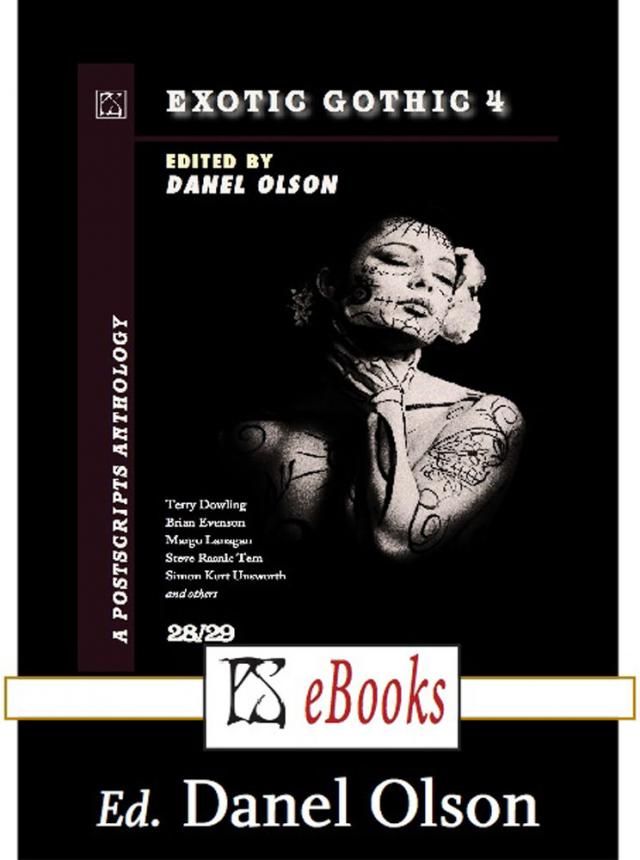
The rapturous cover image for Exotic Gothic 4 reminds me of a Gothic compliment an artist once gave a woman of dark regard. It was Diego Rivera who said to Mexico’s first film star with global appeal, Dolores del Río, ‘Skulls as beautiful as yours never grow old.’1 Having gazed a while on this matinee idol’s glamour stills from the 1920s-1950s, I can see Rivera had a point. Something arresting as death and reimagined as desire pulls at us in the sculpted screen siren’s perfect cranial, cheek, chin and jaw bones. Something fey in del Rio’s geometry of bone fetches. The lines have allure, just as they do in the young woman who recently daubed body paint and clasped her throat for our cover, Anna Flores, gorgeously photographed by Apolinar Lorenzo Chuca, Jr. I believe that the skull beneath her skin will never grow old either.
Granted, skull appreciation can be a bizarre, conversation-halting, and mostly unwholesome fascination to share with women, save for those wondrous ladies of the World Horror and World Fantasy Conventions. They are the unwelcome and slightly obsessive words to bring a draft of mortality to the chat, a hint of perversion, a silence to laughter, a crossing of knees and a looking-away. They are not quite understood. They discomfit all with a nervous Poesque observation, a “Berenice” chill, even evoking the unstoppable and horrid passion within Nancy A. Collins’s instant bone-classic from 1993, “Aphra”. Such words make the champagne in our flutes go instantly flat.
But could there be any more sincere love than skull-love? To say one fancies a woman’s spider-’n-web tattoo is one thing, but a bone plaudit pledges so much more: it says that beneath all—really under it all—she is eternally beautiful. And what compliment goes under the skin more boldly than that? Cranium praise, then, is as guileless and potent and true, as deep a declaration of beauty today, as when the muralist Rivera uttered it over half a century ago.
Likewise, Gothic fiction—that genre of things wrongly hungered for and things wrongly alive—collects and parades its skull trophies, too. The one thing I’ve noticed about skulls is that they’re always smiling, always inviting you in, just as the Gothic smiles at us, at first anyway, and tempts. It is the literature evoking the combined force and surrender to beauty, passion and horror. It reaches to kiss whatever is eternal, infinite, archetypal. Within its plots that dissemble and terrify and seduce, and its characters who follow desire (burying misdeeds and people, or disinterring and resurrecting them as in that flawless Kelly Link story of boneyard boo-boos from 2007, “The Wrong Grave”), the Gothic lets the dead walk with us a little and talk. The Gothic invites the deceased to pull us their way, away from all the pedestrian realities that could dull us or leave us satisfied with less. Following insane desire, stripping the symbolic or literal flesh away from reality, what exactly will you find from these dead ones? You will find stories like these.
Though they aim for re-invention and new culture infusion, some element of the traditional Gothic will always float over the twenty-five neo-Gothic tales herein. What the mysteriously durable Gothic has always done is to supply a curse, bad or absentee parenting, damaged or hidden heirs, shocking human coldness, and murderous disputes over legacy or land. What else the Gothic does is well illustrated recently by my colleague Jerrold E. Hogle in The Cambridge Companion to Gothic Fiction. The Gothic, to paraphrase Prof. Hogle, traditionally leads us to an antiquated or seemingly antiquated place (castle, palace, abbey, ruin, prison or dungeon, crypt, woods or moors or sea, ancient city or culture, underworld, factory, laboratory, or theatre). Within this space are hidden some secrets from the recent or long ago past that haunt the visitors physically or psychically. The hauntings take many forms—they may be voices, visions, ghosts, transformed beings, monsters that rise from within or invaders that come from without, all manifesting in unsolved, unending crimes or conflicts that will no longer stay buried from view. The released threats to sanity, safety and life result in violence, grotesquerie, dissolution, or revolting revelation.2
Many of the writers within the pages of this Exotic Gothic 4 will escort us to such menacing places of revelation, but with 21st century renovations. To tell the same Gothic story, in the same locale and structure, would be as pointless as it is unchallenging—it’s all been done well (or abysmally and melodramatically) too many times before. As Count Earl ironically says in the 2001 video game Cel Damage, ‘We classic monsters are all the same.’ Such a bland or disappointing repetition, and all plunked right back into the Gothic UK homelands, is undesired. A redefinition of the Gothic is hungered for. Part of the dark delight anticipated for readers is watching the Gothic move out of its mouldy grave on this rare moonlit night, and all the never-seen horrors it will visit upon the nearby inhabitants. For example, the infamous private ‘filthy workshop of creation’ from the days of Frankenstein becomes in our anthology a shared St. Petersburg university laboratory with an interest in cancer growths. Mixing Shelley’s revitalization preoccupation with Poe’s mania for possessive romance, Moscow-born Ekaterina Sedia floats a rumor of an amorous tumor in her Russian mad science tale “Helena”. Her story may be the best example in fiction I know to prove a line of Roland Barthes that has stayed with me long: ‘The hallucinatory psychosis of desire not only…brings concealed or repressed desires to consciousness, but, further, represents them in all good faith as realized.’3 Ivan Sechenov the researcher gets what he wanted, but more than he can control, and that’s the damnable Gothic fix. Oppositely, thwarted sexual desire is a theme of Nick Antosca’s new story of mind altering chemicals, “Candy”. And like one of the maddest of its Gothic progenitors—The Monk of 1796 from Matthew Lewis—the wild end for the increasingly unstable protagonist in “Candy” takes place at the water, though in this case at a series of swimming pools instead of the swelling river at The Monk‘s close, where Lewis’s Ambrosio falls from precipice to precipice, first being taunted and scolded for pages by an insatiate daemon, and then dropped from a great height, falling mangled all the way.
In his original “Celebrity Frankenstein” contribution, famed Gothic and Ghostwatch creator/screenwriter Stephen Volk has medical science create a neo Frankenidol for his media-creator, agonizing not all over Antarctica, but a much colder place, Hollywood—the city of wayward agents, dashed callback hopes, broken studio promises, and subpar creative instincts to make movies and TV the same but different from whatever is the current box office or network bash. A black and baleful monster you’ve probably never seen, and would cause other monsters blob-envy, hungers for you in Simon Kurt Unsworth’s hot and dusty African tale, “The Fourth Horse,” along with old-fashioned Gothic longing and lust for a woman who’s no good for you, and the question of who will inherit the land. And while it is hellish enough to face monsters who stand (or roll) in front of you, it is more diabolical to contend with those monsters who are inside you, as we encounter in an unsentimental and unsparing new story of old New England from Scott Thomas, “The Unfinished Book.”
As promised in the timeless schoolyard taunt rhyme K-I-S-S-I-N-G, we spy in Lucy Taylor’s animalistic Namibian narrative “Nikishi” some fateful kisses; then comes love for a real doll in Stephen Dedman’s jaw-dropping “The Fall” of Japan; an easy marriage, but a devilish morning-after manifests in Margo Lanagan’s relentlessly absorbing “Blooding the Bride”; then come the babies from Cherie Dimaline’s First Nation-inspired “Wanishin,” little ones for which no parenting class could well prepare you; and in Anna Taborska’s haunting “Rusalka” comes a final cradling. ‘Whatever love may be,’ as the poet Howard Moss once admitted in “At the Algonquin,” ‘it’s not chil d’s play.’
Just as Rivera’s skull-exclamation was a dark gift to his old friend Dolores del Rio—an artist’s sigh at the windswept curve of her cheekbone—the newfound Gothic between these covers offers lots of unexpected presents just for you. Del Rio’s fantasy-launching bone structure was simply a chance gift of her parents’ union, that random DNA combination they formed that would bless her career and fill the hearts of lovers and audiences worldwide. I suspect that the connection between most of these twenty-five stories is a more deliberate one. They all choose to meditate on dark gifting. That is, they explore what it means to get a something you don’t know how to use, and didn’t ask for, and which may put your mind, body and soul in peril. This isn’t exactly new. We all know well that haunting subtitle to Frankenstein. We all remember that Victor Frankenstein was symbolically a new Prometheus who gave a new kind of fire, a sin for which (like the old Prometheus) he would suffer horribly, and which would present a host of unintended consequences for us.
What is fresh is the form these presents take, and how the characters either search for or give up on redemption after getting and acting upon these odd treasures. Some of the gifts are knowledge that resolves one doubt but raises another, over who your mother or father or in-laws really are, or who your baby is, or who your spouse or neighbors or colleagues or teachers or students are—as in the case of the heartbreaking and heartstopping stories from Tunku Halim (“In the Village of Setang”), Adam L.G. Nevill (“Pig Thing”), Joseph Bruchac (“Down in the Valley”), David Punter (“Carving”), Brian Evenson (“Grottor”), and the aforementioned tales of Margo Lanagan and Cherie Dimaline. So often these invitations in the preceding stories are to stay a while in an otherworldly spot, though you can’t at first for the life of yourself say why. But other gifts are inscrutable things. Outside of these freshly created stories, consider for a moment a few of the strange gifts presented in outstanding Gothic novels and novellas since 2000: the strangely scented, rather countryish dark suit that comes in the mail (from Joe Hill’s Heart-Shaped Box), a feather and bones (Louise Erdrich’s Four Souls), a short metal bar (James Lasdun’s The Horned Man), an endless variety of ice (Dan Simmons’ The Terror), a rotten pumpkin (Nancy A. Collins’s The Pumpkin Child), a picture of a dragon (Elizabeth Kostova’s The Historian), or a body part or two from a dead prostitute (James Reese’s The Dracula Dossier). Another Gothic gift is willing victims, or characters who stay too long or voluntarily return to the locus of horror, that gifted site of gruesome transformation and death, and they enchant another genuinely daring artist of ours, Adam L G Nevill. Nevill terrifies with tales and novels of non-conformists or anti-socials seeking the reward of refuge, but they always choose the wrong sanctuary – going into hallways with hidden light switches and unquiet, teak-floored flats in London, or the witchy tunnels and Brown Man-haunted beaches near St. Andrews, Scotland, from his unputdownable Banquet for the Damned (2004). In response to my argument that what the Gothic most gives is a whole swag-bag of phobias we didn’t know we had, Prof. Glennis Byron (co-creator of the impressive “The Gothic Imagination” website out of Scotland’s University of Stirling) added,
The idea of dark gifting is intriguing—I think you’ve really hit on something important there. Other examples came immediately to my mind, and not just from texts included here (the book and the pen in Shadow of the Wind, the guns in Piñol’s Cold Skin) but many from books published even more recently—like the Barrington House flat in Adam Nevill’s Apartment 16 (2010). No doubt there’s a PhD in this for someone!4
In their own peculiar way, the narratives you’re about to read often feature the non-returnable gift of a damning glance, that one look that nets the eyes: for a start, that glimpse of fabled creatures in Isobelle Carmody’s moving “Metro Winds” and Paul Finch’s devastating WWI “Oschaert”; or a historical picture that kills in Robert Hood’s Mexican revolutionary tale, “Escena de un Asesinato”; or an intimate past in either Genni Gunn’s tearful “Water Lover”, Reggie Oliver’s calmly cruel and caustic “The Look”, or Terry Dowling’s head-twirling “Mariners’ Round”.
So much depends on what one does with these presents. This is the emotional and intellectual bridge that these neo-Gothic tales bid you to cross…What should you do with these gifts? How will the experience change you? Would you ever leave behind what you witnessed? Could you live with what you did? I reckon you won’t believe how these characters use their presents.5
Coming to the end of compiling and editing this book, I asked, What is the Gothic for anymore? It would captivate me to hear what readers of this new collection say. Is it to romance? To imagine swoony and ripped, but rather unscary lovers? That has been enormously popular lately, and Stephenie Meyer has a lot to answer for. The commercial success of all tame vampire and werewolf lovers could turn scores more novelists and screenwriters to churn an anemic and undemonic Gothic that has lost its roots of mayhem and debauchery. Where is the necessary premeditated sin and delayed guilt, parental recklessness, desperate materialism and ill-gotten wealth, devil deals and moral buy-outs, murderously wicked estate or territory battles, and unwilling seductions? When the über figure of the Gothic—the vampire—has been reduced to a softhearted and mumbling boy, and quite capable of love, maybe even a purer love than our mortal kind (enter Edward Cullen), then we are in big trouble. We then have no great monster story but a little romance, and a shamefully abstinent one at that! What is to dread about friendly monsters? Sanitize the diseased Gothic with a purer love-story, about some queasy boy who sits at the edge of your bed at night to look at you, and all the meaningful and shocking stages of G-horror die. Killed off is the significance of sexual temptation and fall, grotesque revelations and unlost monsters, the fight for one’s soul and for sanity, and the long effects of trauma and sorrow and unforgiven deaths. How cathartic may a Gothic story be, if it is afraid to get a little bloody and bone-crunchy?
Perhaps the best Gothic exists now to chill, make us fear, make others fear by doing a little haunting of our own, to scandalize, to anger, to titillate, to question, to cry, to make insane, to warn, to identify oppressors and trespassers, to provide omens, to show off the monsters, to arouse unspeakable hungers, to make us love to the point of madness and despair, or to make it seem as if the top of our heads have just fallen off. Or is reading the Gothic novel like watching someone blush, revealing in that involuntary response something duplicitous or secret in our midst, as it does in poet James Lasdun’s perfectly slippery neo-Gothic novel, The Horned Man (2002)? Might this obsessive sub-genre, at its most terrifying, be doing all of the above to us? One grand collector of horrors and secrets—two key elements of the Gothic tale and novel—is London teratologist Stephen Jones, showcasing the monsters in The Mammoth Book of Best New Horror series now for over twenty years. Jones shows no sign of embracing ‘horror lite’ or ‘pillowtop Gothic’, and provides a needed corrective to the worrying trend the Twilight pall casts. The stories he chooses have dependably sharp claws and filed teeth—the antagonists have spikes which they may hide or not, the plots are dangerously unpredictable, and the streets and paths still seem potently and engagingly malevolent, enough to endanger any protagonist. One perfect original story of teetering, unexpected Gothic victimhood and intoxicating sensuality he debuted for another collection is Sarah Pinborough’s “The Bohemian of the Arbat” (in Summer Chills, 2007), which re-shuffles the Gothic cards masterfully. This tense study of a young, privileged, experienced, and beautiful married woman’s doomed visit to Russia, and the artistic monster of Moscow who refashions her, has become a cautionary favorite of mine and my Gothic fiction students, especially those who have ever considered modeling.
Naturally, much of what each reader gets from the Gothic depends on the culture he or she lives in, and how the Gothic reflects the trauma of our times. Right now, for a North American reader, the Gothic story seems almost a chronicle of what we are enduring—a sympathetic expression to the violent extremes, and the resulting rage and mourning and helplessness, at the abductions and ransoms, rapes, and executions near the U.S./Mexico border. My students now call Juarez, Mexico (just on the other side of El Paso, TX), the City of Missing Women, and they are not terribly surprised that its staggering violence has inspired a couple of video games. They and I wonder at the secrets behind the still unsolved slayings (and sometimes the torture and flaying) of 500 young women or feminicidios, whose bodies have resurfaced in the vacant lots and desert areas near Ciudad Juárez, which now has the highest murder rate in the world.6 The psychological Gothic, that paranoid kind, the type that looks into the passion and pathology of power is invoked by such savage and unprosecuted crimes. And the classic Gothic distrust of authorities (which has been alive at least from Lewis’s The Monk onwards) is reiterated by a recent United Nations investigation into the Juarez murders of girls and women which highlighted the ‘inefficiency, incompetency, indifference, insensitivity and negligence of the police who investigated these cases.’7 An incapacity to properly investigate the crimes and to punish the guilty is one thing, but what’s worse is the stinking Gothic suspicion of cover-up. This is a dread echoed in an American official’s disturbing conclusion: that ‘Chihuahua state police officers, the same public servants charged with solving the women’s murders, were likely behind numerous rapes and killings.’8