Court, p.1
Court, page 1


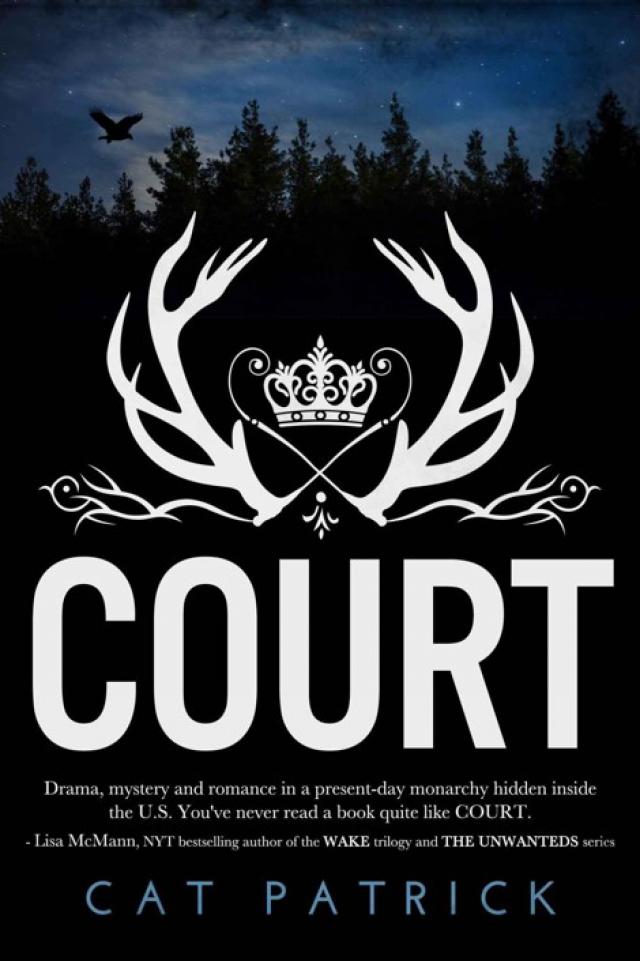
COURT
by Cat Patrick
Copyright © Cat Patrick, 2014
All Rights Reserved. Except as permitted under the U.S. Copyright Act of 1976, no part of this publication may be reproduced, distributed, or transmitted in any form or by any means, or stored in a database or retrieval system, without prior written permission of the publisher.
This e-book is a work of fiction. While references may be made to actual places or events, the names, characters, incidents, and locations within are from the author’s imagination and are not a resemblance to actual living or dead persons, businesses, or events. Any similarity is coincidental.
This e-book is licensed to the original purchaser only. Duplication or distribution via any means is illegal and a violation of International Copyright Law, subject to criminal prosecution and upon conviction, fines and/or imprisonment. No part of this e-book can be reproduced or sold by any person or business without the express permission of the publisher.
Cover Design: Paper and Sage Design
Interior Book Design: Shirley Quinones
For my parents.
And for my state.
Audentes fortuna juvat.
Fortune favors the bold.
—Latin proverb
HAAKON
Before he was the enemy, James Haakon McHale III was just a seventeen-year-old in what most people knew as the state of Wyoming, wishing he was somewhere other than the predawn forest with a rifle in his grip.
“It’s colder than moonlight on a tombstone,” Haakon muttered, blowing on his fist. His thick-soled boots swish-thumped on the hard earth as he skillfully avoided twigs, rocks, and low branches.
Alexander Oxendine—youngest son of the Duke of Wind, wide receiver, video game button masher, and Haakon’s best friend—laughed into his collar. It could’ve been mistaken for a cough.
“It’s colder than a whore’s heart,” Alexander said, his tone cautiously low. They were the youngest members of the hunting party, and were only allowed to take part because of their rank. Haakon could think of a thousand superior privileges.
He glanced around to make sure none of the other men were paying attention—especially his father. Smirking, he said, “Colder than a polar bear’s balls.”
The pair stifled laughter.
“Than a witch’s—”
“Too easy.”
“Colder than a dead woman’s touch,” Alexander said.
Haakon checked again, dialed down his voice even more, and said, “It’s colder than Gwendolyn Rose’s kiss.”
“Quiet!”
It was Haakon’s father: dictator, fun-spoiler, and—regrettably for his son—the tenth ruler of the Kingdom of Eurus, also known as the Realm, the monarchy hiding in plain sight in the depths of the Democracy known as the United States of America.
Every schoolchild knew the story. In 1670, after Joseph Dyer’s wife died in the Great Plague in London, he brought his five daughters to what would become the United States one hundred years later, seeking a better life. But it soon became apparent that his family would never thrive under strict Puritan rule in New England–which banned higher education for girls and taught submissiveness above all else, and which centered around extreme religious beliefs that were counter to Dyer’s own.
A friend, John Seymour, who was—controversially—married to a Native woman, suggested that they set out together in search of a new home deep within America’s treacherous unknown. Seymour’s wife had been attacked; her family persecuted. Seymour believed that rather than fighting the Natives, they should live in harmony with them.
Dyer, Seymour, and several other men and their families snuck away. After a long and dangerous journey, together they created their version of paradise: a kingdom that blended the best of England with Native cultures. Dyer was thought of as the Father of the Realm, and Seymour’s Native wife, who ensured their survival through tribal relations, the Mother.
Rather than cause a revolution, the founders decided to keep the kingdom secret. Inside the borders of what they’d eventually stake claim as Wyoming, they’d follow their own rules. Outsiders wouldn’t know they were different because they wouldn’t understand.
Outsiders weren’t to be trusted.
Dyer’s youngest daughter, captivated by the ancient Greek she wouldn’t have been allowed to learn in Puritan society, named the new kingdom Eurus, meaning east wind. She pronounced it “air-us.”
“But the winds here blow from the west,” Haakon had asked his father once—before Dad was King James. That was when it was okay to ask questions. When curiosity wasn’t an imposition.
“That’s right, Haakon,” his father had replied, straw between his teeth. They’d gone on a walk together. The sun was setting on an easy day. His dad had pointed toward the eastern horizon. “The wind here does primarily blow from the west, but our founders blew in from the east. That day, the wind changed directions.”
Haakon frowned away the memory of days never to return, and refocused on the trees. He walked as soundlessly as he could in his camo fleece jacket and vintage Levi’s, his rifle nestled in the crook of his left arm, a round in the chamber. He was on the left edge of the group, three rows behind his father. Evenly spaced gaps between them, the men were like migrating geese, locked in formation.
Geese hunting deer.
“Were you drinking last night?” Haakon’s father had demanded on the way to the meeting point that morning. “Is that why you’re so tired?”
“I’m tired because it’s so early that the birds aren’t even awake yet.”
“Good. Because you know what the consequences will be if you start drinking again.” They’d shared the backseat of the armored SUV; Haakon had done his best to preoccupy himself with his cell phone.
“Yes, sir, I know.”
“You need to turn that thing off before we arrive. And when’s your next haircut? You look slovenly.”
Will you just get off my back? Haakon had thought at the top of his lungs. What he’d said, though, was simply, “Yes, sir.”
There, in the forest, Haakon toyed with the idea of raising his gun and shooting King James square in the back of the head. Right there under his hat, just above the rise of his custom down hunting vest. He could do it. Even with the others present, he knew there’d be no trial, no trip to Corby. But offing his father wouldn’t solve anything. In fact, it would make life a lot worse. Because with his father gone, Haakon would be in charge.
Haakon would become the King of Eurus.
The thought made him want to puke.
Swallowing hard, he tried to center himself, except his bright orange skullcap was itchy and he was both hot and cold at the same time. He wanted to shed his clothes and have a certain blonde drag her nails around his back.
A crow called in the distance, arresting Haakon’s thoughts.
Most everyone believed the ancestral view that crows were guides, there to help people from one place to another—even from life to death. But Haakon’s grandfather, the first James Haakon McHale, whom everyone had called Hawk, had thought crows harbingers—warning signs that something, or someone, was coming. Haakon had never liked the ominousness of fortune-telling, especially by a bird. He listed hard for more from the crow. Instead, even before he caught sight of it, he heard the stag.
It came from the left. The deer’s antlers knocked against the tree trunks as he made his way through the dense forest, the sounds growing more noticeable with his approach. Sir Malcolm Rose, Duke of Coal and Haakon’s future father-in-law, stopped and raised his massive right hand in a fist, and the group held.
Hunters in windbreakers lifted binoculars to their faces, but Haakon didn’t need them: he saw the stag with naked eyes. Dirt brown the color of the forest floor except for white patches on his snout, ears, and ass, the deer was commanding and unafraid, staring down the group, challenging each man to a fight.
Dumb animal, Haakon thought. Run. Live.
“Boy.”
It was barely audible: such a small word. A word that could be filled with light and love, or, as in this context, an order. It was only three letters, but he got its meaning. It was enough.
Haakon raised the rifle that he’d learned to use before his father had prematurely pried the training wheels from his bike, and nestled the butt into his broad shoulder. Releasing the safety, securing his right hand around the grip, he thought again of his grandfather, Hawk.
“The breath is critical,” Hawk had told Haakon every time they’d gone shooting on the plains. “Inhale, then exhale slowly, but only halfway.”
“Why only halfway?”
“Halfway is when you’re steady. Halfway is when you shoot.”
Haakon remembered the pfft pop of the bullet making contact with empty bottles of Macallan, Glenfiddich, and Laphroaig, the tinkle of glass shattering and showering the boulder below.
He’d always return home with prickly sandburs clinging to his socks and shoelaces, biting his fingers when he tried to untie his shoes, but he’d never minded. He loved every moment he’d spent with Hawk, even the colder days—maybe especially the colder days—when he could stand downwind and inhale the savory spiced aroma of cigar that’d enveloped his grandfather until the end.
The day Hawk died was the first day that Haakon had gotten drunk. He’d downed three quarters of one of his grandfather’s most prized possessions: a fifty-eight-thousand-dollar bottle of single malt scotch made in 1943. It’d tasted like fire going down, and a lot worse on the way back up.
It hadn’t done much for the pain long term, but it’d numbed Haakon’s heart for a few hours at least.
“You’ll miss your window,” the king said, his voice rumbling and powerful like a thunderstorm across the border. “Take the shot or I’ll do it myself.”
Envisioning the lecture of a lifetime should he miss the opportunity, Haakon put his finger on the trigger, holding the gun steady with his left hand around the forearm. Through the scope, he got an even better look at the animal: he was majestic.
Run, moron.
Haakon’s heart clenched. He wasn’t some tree-hugging vegetarian, but he didn’t get his rocks off by taking a life.
Last chance. Run.
The animal didn’t run. Sick to his stomach, Haakon rationalized that the deer would provide meat for the community. That there would be one less stag stalking the roads, causing accidents. Overpopulating the mountain. And were those unbalanced antlers? The deer appeared to have a drop tine, which meant he was genetically inferior. Probably destined to die anyway.
Probably.
The king cleared his throat and made a move to raise his own gun. Haakon knew the time to act was now.
He took the breath.
Halfway is when you shoot.
Slowly, deliberately, he squeezed the trigger.
The bullet leaving the chamber cracked the silence in half. Its echo played pinball on the trees and forest floor, so disturbing to the wild that birds sent up distress calls, four-legged animals fled, and even the trees themselves seemed to hiss shh! at the kid with the gun who craved his warm bed and last night’s sports highlights. Haakon felt a twist of sadness, of regret, as he watched the mighty animal fall, flailing against death on the way down. It was a good kill—a solid hit to the rear of the shoulder, near the vital organs—and he looked over at his father, expecting a rare but obligatory look of approval.
Instead, there was chaos.
The knighted Mattias DeVille—the king’s most trusted friend and protector—was sprinting through the forest away from the group, several men as shadows, guns gripped tightly and ready to fire.
Haakon called out to Mattias, “Where are you g—”
A human form hit him, shoulder to hip, and Haakon went down, the side of his head slamming against the dirt. Instinctively, Haakon tried to break free.
“Stay down,” Malcolm Rose hissed into Haakon’s ear. Gwendolyn’s father had Haakon pinned like they were waiting for a ref to call a play.
“What are you doing?” he demanded, writhing on the ground, trying to escape. “Get off me!”
“I’m protecting you, for God’s sake!” Malcolm said. “Stay still! We don’t know who else is out there!”
Overwhelmed by confusion, Haakon stopped struggling. It was then that he heard shouts of, “Over here!” and “I think I found tracks!” from the forest. Frantic footsteps pelted the ground. Closer, there were unrecognizable rhythmic grunts.
“What is that?” he asked, his pulse racing. Something was very wrong.
Malcom didn’t answer, but he let Haakon go. From the ground, Haakon watched Malcom rush to a circle of men crouched near the base of two trees growing like a crooked V. He stood and turned in a full circle, scanning the forest for…anything. But there was nothing out of the ordinary. Nothing that hadn’t been there before. Feeling exposed, Haakon moved closer to the group.
“No, Haakon, wait,” Alexander said, emerging from the cluster of bodies with an expression that Haakon had never seen on his friend’s face. Alexander swiped at his ruddy cheeks. “Don’t look.”
Dazed like he’d been drugged, Haakon weaved around Alexander’s outstretched palm to peer into the center of the circle. He didn’t recognize the man-size rag doll crumpled there at first.
But then he did.
“Dad?” His pulse skyrocketed when he saw a charred hole in the king’s vest. “Dad!”
Haakon’s scream didn’t seem to stop.
He fell to his knees and rocked back and forth as he stared at his father, who was lying in a lake of blood that looked too dark to have come from a human, too plentiful to have come from a living creature. Hands attached to arms attached to a faceless form were covered in the sticky ooze, like they’d tried to plug the hole.
The hole in his dad.
Someone had shot his dad.
His dad, King James Haakon McHale II, was dead.
Haakon covered his ears with his forearms, lacing his fingers behind his neck and falling forward against the dirt.
“This can’t be happening,” he chanted over and over to himself.
With his ears covered, Haakon was in a bubble, only able to hear his own voice and the thumping of his own pulse. He stayed that way until his feet went numb and prickled. He stayed that way until hands guided him up and away, led him to the SUV, and drove him home.
Five hours later, after writhing through three bouts of dry heaves, Haakon slumped in a chair near the fire in the larger of the two castle libraries, unprepared to listen to what the Council had to say. The Council consisted of the dukes of the Five Families (responsible for Natural Gas, Coal, Wind, Tourism, and Oil); the highest ranking knight, Mattias DeVille; the Almoner, Boyd Harris, protector of the sick and those otherwise in need; and Haakon’s mother, Queen Katherine. Normally an advisory committee to the crown, the Council was, at least for the moment, in charge.
“It’s late, so I won’t mince words,” Malcolm said, still wearing his hunting flannel and jeans. In charge of Coal, the second most profitable resource in the Realm, he had power. “As per the laws of the Kingdom of Eurus, the oldest child of the king shall take the throne in the event of the king’s death.”
Everyone in the room looked at Haakon. Disoriented, he ran his hands through his hair. He felt a patch of chunky wetness that could have been vomit.
“You can’t be—” he began, but his throat was so dry, the words cracked like desert sand. He swallowed, and said, “I’m only seventeen.”
“We are well aware of your age,” Malcom Rose said. “It was taken into consideration. But we’re a three-centuries-old kingdom, son. We can’t start cherry-picking the laws we follow now.”
Haakon didn’t want to be called son by anyone, especially Duke Malcolm Rose.
“The Council can change the law.”
“The Council doesn’t have authority to change laws.”
“What about the Clan Mothers?”
Malcolm stifled a laugh, which probably offended some in the room. Elected officials, back when Eurus was founded, the Clan Mothers were as important and powerful as the Council. Somewhere along the way, their power had been diluted.
“Only the king can change the laws,” Haakon’s mother said.
“Then I’ll become king and change this one.” Haakon felt like he was falling. “I’ll become king and name someone else ruler immediately.” He looked at his mother, who had dark circles under her eyes but was otherwise composed. “Or queen.”
“It doesn’t work that way,” she said quietly. “I will help you, but I can’t rule for you.”
Succession laws in Eurus in many ways still looked like England’s, with crowns inherited by blood, not marriage.
“I don’t know how to be king.” Haakon felt tears sting his eyes and heard his father’s voice chastise him.
Be a man, Haakon. No one respects a crier.
“Neither did your father when he took the throne,” Sir Mattias DeVille said softly. He and Haakon’s dad had grown up together: the politician and the protector. “He learned, as will you. And you’ll have an entire Council backing you.”
Haakon looked pleadingly at Alexander, whose eyebrows were pinched with worry. His pumped-up arms were folded over his chest; his auburn hair looked like he’d been trying to rip it out.
“Prince Haakon James McHale III, in nine weeks, on the first of the New Year, you will be sworn in as the eleventh ruler of the Kingdom of Eurus,” Malcom Rose continued formally, completely ignoring Haakon’s protests.
“What’s more,” he went on, “the Council members have unanimously agreed that prior to your coronation, because you are still quite young, in order to make you appear more mature in the eyes of your people, you should in fact be…” His voice trailed off. Haakon quickly learned why.